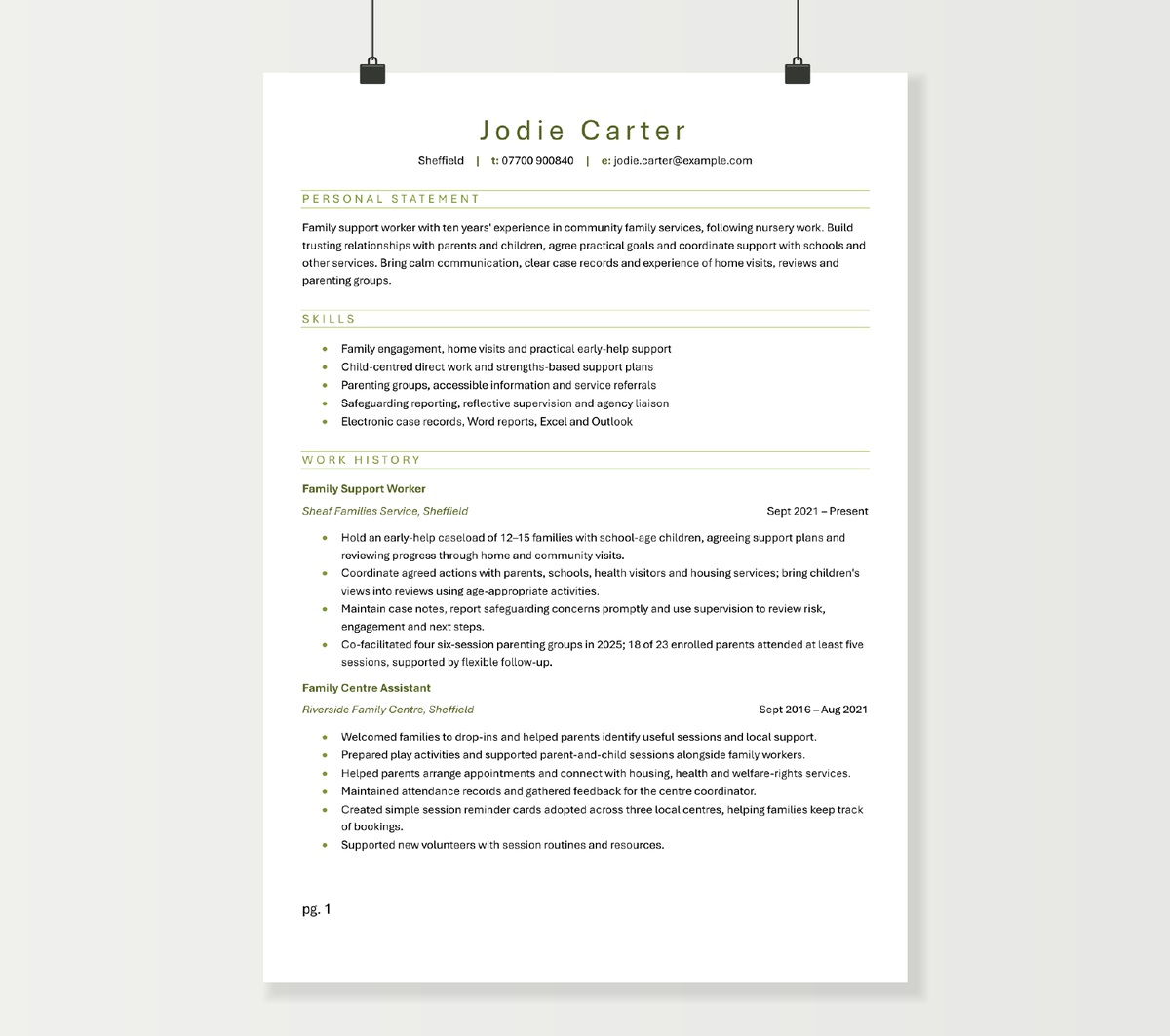
This family support worker CV template shows progression from childcare and family-centre work into an early-help caseload. The Word example covers home visits, support planning, work with partner services and parenting groups. The guide helps you present the contribution you make to families, children and coordinated support in community, school or specialist settings.
Filename: FreeCVDownload_Family_Support_Worker.docx
Content of this CV template
Jodie Carter
Sheffield | t: 07700 900840 | e: [email protected]
Personal statement
Family support worker with ten years' experience in community family services, following nursery work. Build trusting relationships with parents and children, agree practical goals and coordinate support with schools and other services. Bring calm communication, clear case records and experience of home visits, reviews and parenting groups.
Skills
- Family engagement, home visits and practical early-help support
- Child-centred direct work and strengths-based support plans
- Parenting groups, accessible information and service referrals
- Safeguarding reporting, reflective supervision and agency liaison
- Electronic case records, Word reports, Excel and Outlook
Work history
Family Support Worker
Sheaf Families Service, Sheffield
Sept 2021 – Present
- Hold an early-help caseload of 12–15 families with school-age children, agreeing support plans and reviewing progress through home and community visits.
- Coordinate agreed actions with parents, schools, health visitors and housing services; bring children's views into reviews using age-appropriate activities.
- Maintain case notes, report safeguarding concerns promptly and use supervision to review risk, engagement and next steps.
- Co-facilitated four six-session parenting groups in 2025; 18 of 23 enrolled parents attended at least five sessions, supported by flexible follow-up.
Family Centre Assistant
Riverside Family Centre, Sheffield
Sept 2016 – Aug 2021
- Welcomed families to drop-ins and helped parents identify useful sessions and local support.
- Prepared play activities and supported parent-and-child sessions alongside family workers.
- Helped parents arrange appointments and connect with housing, health and welfare-rights services.
- Maintained attendance records and gathered feedback for the centre coordinator.
- Created simple session reminder cards adopted across three local centres, helping families keep track of bookings.
- Supported new volunteers with session routines and resources.
Nursery Practitioner
Little Acorns Nursery, Sheffield
Sept 2013 – Aug 2016
- Supported children aged two to four as a key person.
- Shared observations and daily updates with parents and carers.
- Adapted play activities with the room leader to support participation.
- Kept development records and followed safeguarding procedures.
Qualifications
Level 3 Diploma for the Children and Young People's Workforce
City & Guilds
2013
- Early Learning and Childcare pathway.
- Completed alongside supervised childcare practice.
- 9 GCSEs, including English and Maths at grade C or above — 2011.
Continuing development
Employer and local partnership training
2025 – 2026
- Safeguarding updates, family support planning, trauma-informed practice, domestic abuse awareness and lone-working training.
Hobbies and interests
- Walking: Weekend routes in the Peak District.
- Baking: Trying new bread and cake recipes.
- Comedy: Visiting local live comedy nights.
Additional information
Full UK driving licence. Enhanced DBS for the child workforce, issued 2021; subscribed to the Update Service.
How to write a family support worker CV
A strong family support worker CV explains how you build relationships and turn them into useful, coordinated support. Employers need to understand the families you have worked with, the responsibility you held and how you helped move agreed plans forward. Warmth and patience matter, but the employment history is where the reader sees those qualities in practice.
The example above follows an early-help career. Other vacancies may focus on school and home liaison, children with disabilities, supervised family time or direct work alongside a social worker. Choose evidence that brings your experience closest to the service you want to join.
Establish the service, families and level of responsibility
Begin each role with enough context to make the work understandable. Give the setting, the age range of children where relevant, the kinds of support offered and whether you held your own caseload. “Supported families” could describe anything from welcoming parents to a drop-in to coordinating a plan involving several agencies.
A caseload figure can help when it is accompanied by its context. For example, Jodie’s CV describes 12–15 early-help families and the home and community visits used to review their plans. The number becomes useful because the reader can see what the work involves. A group-work or school-liaison post may be better described through the sessions, school population or particular service you supported.
Explain your part in planning and decision-making. You may have been the family’s main contact, coordinated agreed actions, delivered a particular intervention or contributed observations to a social worker’s assessment. Those are all valuable responsibilities. Clear wording lets an employer recognise the level at which you have worked and how it connects with the new position.
Use the profile to bring these details together briefly. Service experience, one or two areas of direct work and the way you coordinate support usually provide a stronger introduction than a series of adjectives about being caring, resilient and passionate.
Show how you engage parents and children
Relationship-building becomes convincing when you describe the work behind it. Think about how you helped a family feel able to attend a first appointment, contribute to a plan, return to a group or raise an issue that had been difficult to discuss. The CV needs a concise account of your contribution and what it enabled.
Relevant evidence could include arranging contact around caring responsibilities, using accessible information, working with an interpreter or offering a familiar community venue. Select an example that shows how you responded to a barrier. This gives substance to strengths-based or trauma-informed practice without requiring a theoretical explanation of either approach.
Give direct work with children its own visibility. State the age group and the kind of communication or activity you used, then explain how the child’s views informed the support. Play-based activities, visual resources or structured conversations can be relevant, depending on the child’s age and needs. The useful CV point is how you helped the child participate and how their perspective reached the people reviewing the plan.
For disability or SEND posts, show how you adapted communication and worked with parents and other professionals. A description of preparing accessible information before a meeting, helping a family organise questions or following up an agreed referral can be more informative than a broad claim of SEND knowledge.
Connect practical support with the agreed plan
Family support often involves many small actions. Present them as connected work so the employer can see your organisation and judgement. Describe the goal agreed with the family, the support you provided and the way progress was reviewed.
For example, a school-attendance entry could cover working with parents and the school to understand morning difficulties, agreeing practical routines and reviewing how the plan was working. A housing-related entry might focus on helping a parent prepare information for an appointment, coordinating with the housing service and following up the agreed actions. This shows the contribution without turning the CV into a detailed case chronology.
Useful areas to draw from include:
- Home visits and planned reviews that helped families work towards manageable goals.
- Parenting support connected to routines, relationships or a child’s particular needs.
- Helping families access health, housing, welfare-rights or community services.
- Supporting participation in school, short breaks or local activities.
- Preparing families for meetings and helping their questions and priorities receive attention.
Select the areas central to your role. An employer should be able to follow a few meaningful examples rather than work through a long list of every service a family might use.
Demonstrate safeguarding practice through your work
A training entry establishes learning; the employment history shows how you use it. Relevant CV evidence includes recognising and reporting concerns, making clear records, contributing information to reviews and using supervision to consider changes in risk or the next stage of support.
Describe the part you played within the service’s arrangements. In a school, that may mean sharing observations with the designated safeguarding lead. In a family-support team, it may involve updating a social worker, contributing to a review or discussing concerns with a supervisor. A short, accurate description of this responsibility is more useful than a lengthy statement about commitment to safeguarding.
Reflective supervision can also demonstrate professional development. You might explain how it helped you review engagement, prioritise visits or adapt an approach with a family. For more experienced applicants, mentoring a colleague or contributing to a team review can show the next level of responsibility.
List relevant safeguarding and practice updates with dates in the training section. Use the terminology of the service and UK nation in which you worked. Where you are moving to a different area, make the underlying experience clear so that local programme names do not obscure what you can bring.
Make multi-agency working and records specific
“Liaised with other professionals” leaves much of your work invisible. Name the relevant partners and explain the purpose: arranging a joint visit, coordinating actions after a review, clarifying a referral or making sure a family’s priorities were included in a meeting.
The quality of follow-up matters. A strong entry can show that you recorded who would do what, checked progress and kept the family informed. This is especially helpful when several services were involved and your role gave the family a consistent point of contact.
Case-recording skills should describe the records you produced. These might include visit notes, support plans, review summaries, group attendance or reports for another professional. Include the case-management system if it is relevant to the vacancy, alongside what you used it for. Word, Outlook and Excel can support reports, visit schedules and service information, but the underlying evidence is your ability to keep work organised and information usable.
A small improvement to the service can be worth including. In the example, reminder cards adopted by three centres demonstrate a practical contribution to communication. Other possibilities include clearer referral information, an accessible session timetable or a handover process that helped colleagues follow up outstanding actions.
Choose outcomes that reflect family-support work
Numbers are useful when they explain reach, participation or progress. They are not the only way to show value. A completed referral, a family taking part in a review or a child being able to contribute their views can provide a meaningful outcome when the entry explains your work and why it mattered.
For group delivery, useful measures include the number of sessions, enrolments, attendance and completion. Jodie’s example gives the total parents enrolled, the attendance threshold and the number of groups. It shows delivery and engagement without asking the reader to infer a broader change in family circumstances from attendance alone.
For individual support, you could describe progress against an agreed goal or a change recorded at review. When several people contributed, a phrase such as “worked with the family and school to…” makes your role clear. If you use a service outcome measure, give its name and the period or group covered so the result can be understood.
Qualitative results also belong on the CV. A parent accessing a service after practical support, a more coordinated handover or a family continuing with an agreed plan may be the most useful evidence available. Choose a concise example that shows both the work and the progress.
Adjust the emphasis to the setting
For a family hub or community service, bring forward outreach, home visiting, practical help, parenting support and links with local provision. Your knowledge of how families access support can be particularly valuable when accompanied by an example of following a referral through.
For a school-based role, show how family liaison supported attendance, wellbeing, communication or participation in education. Evidence from pastoral work, a family centre or classroom support can transfer well when you explain the contact with parents and the actions coordinated with school staff. The teaching assistant example may help applicants organise relevant earlier school experience.
For children-with-disabilities services, give space to communication needs, partnership with health and education, access to short breaks or community activities, and the family’s role in planning. For posts alongside statutory social-work teams, make direct work, observations, reports and contributions to plans and reviews prominent. The target service should determine which examples receive most space.
Present qualifications and your route into the role
Give the full title, awarding body and year of relevant childcare, health and social care, youth-work or family-support qualifications. Include a pathway or specialist option when it helps explain your training. Jodie’s Level 3 qualification establishes her childcare background, while her later employment shows the move into wider family work.
Choose recent development that supports the responsibilities you are presenting. Safeguarding, domestic abuse awareness, child development, disability, group facilitation and relevant intervention training can all be useful. If you deliver a named programme, state your training or delivery status and connect it with the sessions you have facilitated.
For a first family-support post, draw on supervised volunteering, nursery work, youth activities, school support or community services. Explain the contact you had with children and parents, the responsibility you held and the records or follow-up involved. The support worker CV can help with presenting earlier person-centred support experience.
Experienced applicants can use more of the page for caseload responsibility, complex coordination, group delivery and contributions to colleagues’ practice. Earlier roles still help explain progression, but they can be shorter once the current role provides the strongest evidence.
Use the CV as a source for the supporting statement
Family-support employers often ask for a supporting statement or structured application form. Keep your CV focused on roles, dates, responsibilities and selected outcomes. Use the statement to develop the examples against the employer’s person specification, including the decisions you made and what you learned.
For a criterion about engaging families, choose an engagement example; for partnership working, use an example involving coordinated actions with another service. This gives each requirement clear evidence and avoids making the statement a longer copy of the employment history. The template library offers other layouts if your experience needs a different balance of employment, volunteering and qualifications.
Family Support Worker CV FAQs
Many family support worker posts accept relevant vocational qualifications and experience in children’s, family or community services. Requirements vary, particularly for specialist posts. Match the qualification section to the person specification and give practical experience appropriate space. A social worker vacancy has a different professional qualification and registration route, even where both roles sit in the same team.
It can provide relevant context, especially when moving into the sector or returning to work. A brief career-break or caring entry can explain the period and the experience you wish to highlight. Alongside it, give supervised volunteering, training or employment evidence that shows how you work with other families, colleagues and service procedures. This helps the employer understand both your perspective and your readiness for the professional role.
You can group assignments under the agency employer and identify each service, role and date beneath it. Briefly describe the setting and responsibilities for each placement so that a school-liaison assignment is distinguishable from family-time or early-help work. Keep the dates easy to transfer into an employer’s application form, and give most space to the placements closest to the vacancy.
A short additional-information line can give the check level, workforce, issue year and Update Service subscription where relevant. An issue date is more informative than calling a certificate ‘current’: DBS certificates have no official expiry date, and the recruiting employer decides which checks are needed for the post. The application process provides the appropriate place for any further certificate details.
Describe the setting, the ages of children where useful and your responsibilities before, during and after sessions. Relevant evidence may include preparing families, observing interactions, supporting agreed activities, recording factual observations and sharing concerns through the service’s procedures. Show how your records and communication supported the professionals responsible for planning the child’s arrangements.