
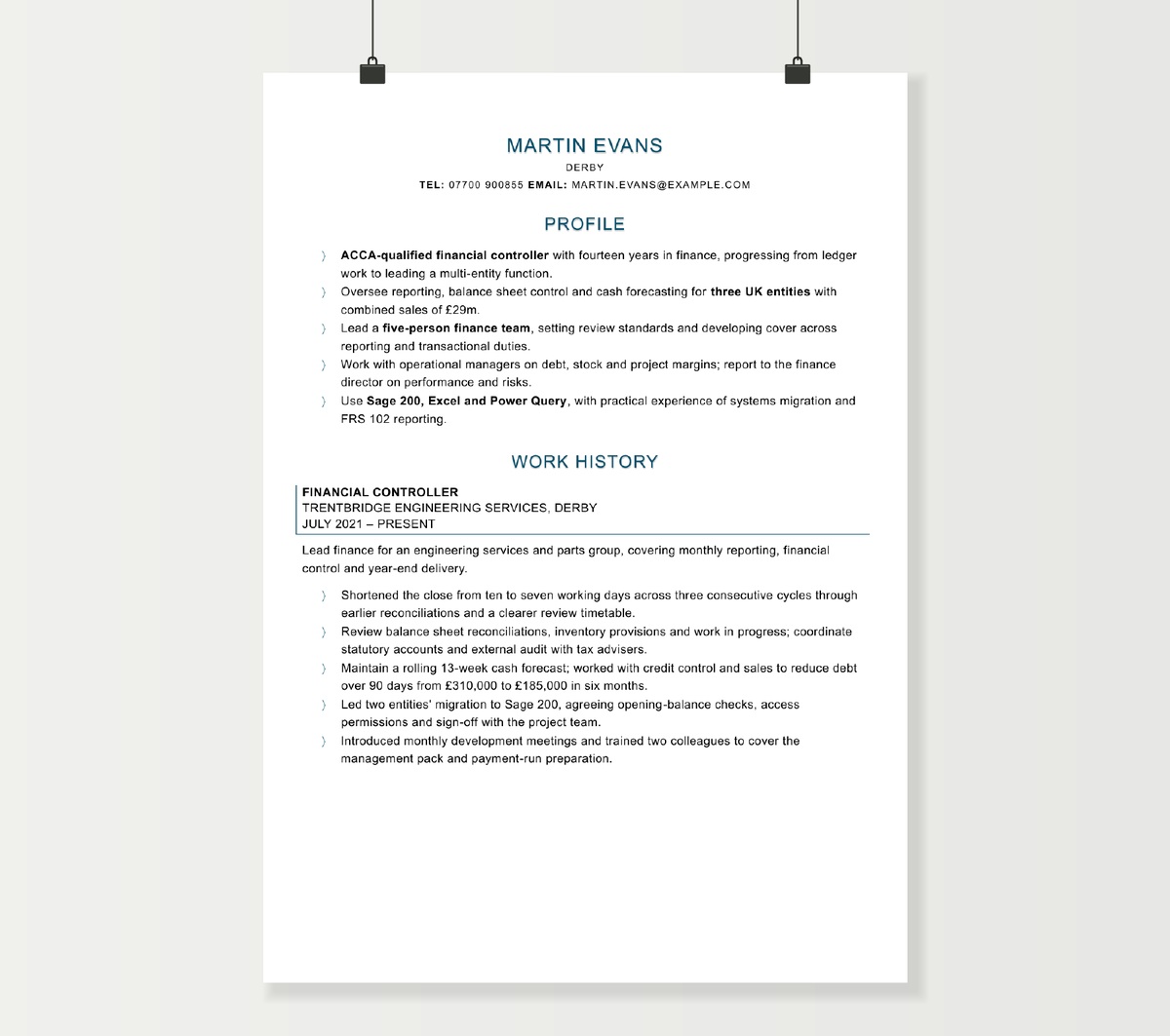
This financial controller CV template follows an ACCA-qualified accountant leading finance for a UK engineering services business. The Word example connects reporting and financial control with cash management, audit and team development. Use the guide to present the scale of your remit and the improvements you have delivered, whether you are an established controller or preparing for your first appointment.
Filename: FreeCVDownload_Financial_Controller.docx
Content of this CV template
MARTIN EVANS
DERBY
tel: 07700 900855 email: [email protected]
PROFILE
- ACCA-qualified financial controller with fourteen years in finance, progressing from ledger work to leading a multi-entity function.
- Oversee reporting, balance sheet control and cash forecasting for three UK entities with combined sales of £29m.
- Lead a five-person finance team, setting review standards and developing cover across reporting and transactional duties.
- Work with operational managers on debt, stock and project margins; report to the finance director on performance and risks.
- Use Sage 200, Excel and Power Query, with practical experience of systems migration and FRS 102 reporting.
WORK HISTORY
FINANCIAL CONTROLLER
TRENTBRIDGE ENGINEERING SERVICES, DERBY
JULY 2021 – PRESENT
Lead finance for an engineering services and parts group, covering monthly reporting, financial control and year-end delivery.
- Shortened the close from ten to seven working days across three consecutive cycles through earlier reconciliations and a clearer review timetable.
- Review balance sheet reconciliations, inventory provisions and work in progress; coordinate statutory accounts and external audit with tax advisers.
- Maintain a rolling 13-week cash forecast; worked with credit control and sales to reduce debt over 90 days from £310,000 to £185,000 in six months.
- Led two entities' migration to Sage 200, agreeing opening-balance checks, access permissions and sign-off with the project team.
- Introduced monthly development meetings and trained two colleagues to cover the management pack and payment-run preparation.
ACCOUNTS ASSISTANT / FINANCIAL ACCOUNTANT
MILLGATE INDUSTRIAL SUPPLIES, DERBY
SEPTEMBER 2012 – JUNE 2021
Joined a regional industrial wholesaler as an accounts assistant in 2012; promoted to financial accountant on qualification in 2017.
- Prepared monthly accounts, journals and balance sheet schedules for the controller, explaining margin and overhead movements.
- Managed intercompany reconciliations and maintained fixed asset and inventory schedules for two trading companies.
- Coordinated audit evidence and drafted statutory account schedules; prepared VAT workings for review.
- Rebuilt the bank reconciliation workbook, reducing unresolved items older than one month from 23 to four over three closes.
QUALIFICATIONS & DEVELOPMENT
ACCA
QUALIFIED 2017
Admitted to ACCA membership in 2017 following examinations, ethics and practical experience requirements.
A LEVELS: MATHEMATICS, ECONOMICS AND HISTORY
DERBY SIXTH FORM – 2012
RECENT PROFESSIONAL DEVELOPMENT
FRS 102 UPDATE – 2026; FINANCE TEAM LEADERSHIP – 2024
INTERESTS
Cycling, restoring old furniture and watching county cricket.
How to write a financial controller CV
A financial controller CV needs to establish two things quickly: the part of the business you control and the quality of the finance operation under your leadership. The same title can describe a hands-on accountant in one company or the leader of reporting, tax, treasury and transactional teams across an international group. Give the reader enough context to understand your particular remit before asking them to assess your achievements.
Define the size and shape of your responsibility
Start each recent appointment with a short scope statement. Useful details include turnover, entities, sites, countries, ownership structure, direct reports and reporting line. Choose those that explain the complexity of the work. A £20m business with project accounting, overseas subsidiaries and tight cash requirements may need a different controller from a larger single-entity operation with straightforward transactions.
For example: “Lead a five-person finance team across three UK trading companies with combined sales of £29m, reporting to the finance director.” Follow this with the functions you own: financial reporting, purchase ledger, credit control, payroll oversight or treasury. If a shared service centre or external provider carries out some activities, explain your review and escalation responsibilities. That distinction helps employers understand how you get work delivered.
A group controller should make consolidation, entity reporting, intercompany relationships and group policy visible. A divisional controller may instead emphasise local control, operational partnership and reporting into a central group function. These are valuable but different forms of experience.
Make the profile a statement of fit
Use the opening profile to connect your qualification, operating environment and strongest evidence to the vacancy. “ACCA-qualified controller with multi-entity engineering experience, leading reporting, cash forecasting and a five-person team” gives the reader a useful starting point. A second sentence might introduce an acquisition integration, a close improvement or experience establishing controls in a growing business.
The order can change with the appointment. A business recruiting after rapid expansion may prioritise reliable reporting and scalable processes. A cash-constrained operation may place more weight on working capital and forecasting. A group undergoing refinancing may need covenant reporting and lender information. Select evidence from your career that addresses that particular situation.
Show what makes the close dependable
Month-end responsibility is common among controller applicants. Explain the controls and decisions within yours: ownership of the timetable, review of journals and reconciliations, resolution of intercompany differences, challenge of estimates, consolidation and approval of the final pack. Name the reporting deadline when it helps describe the pressure or improvement involved.
A close reduced from ten to seven working days becomes more useful evidence when the reader can see how: moving reconciliations earlier, allocating review responsibilities or fixing recurring source-data problems. Include the period over which the result held. Where speed stayed the same, better review coverage, fewer late adjustments or a cleared reconciliation backlog can demonstrate progress.
Balance sheet control deserves its own evidence. Choose the accounts that mattered in your business, such as inventory provisions, accrued project costs, deferred income, fixed assets or intercompany balances. “Reviewed the balance sheet” leaves a great deal unexplained; a line about resolving aged reconciling items or establishing documented review of a material estimate shows the substance of the work.
Connect cash responsibility to operational action
Distinguish preparing a cash forecast from using it to influence decisions. State the horizon, frequency and inputs where relevant, then show what happened as a result: a revised collection plan, a changed purchasing schedule, better visibility of funding needs or agreement on capital expenditure timing.
Working capital achievements benefit from both a measure and a business explanation. An aged-debt reduction can sit alongside your work with sales and credit control; an inventory reduction can identify the planning or purchasing colleagues involved. This gives proper shape to the controller’s contribution and shows the relationships needed to sustain it.
Where treasury is significant, specify your involvement in facilities, covenant calculations, bank reporting, foreign currency exposure or cash pooling. A controller preparing lender submissions has a different role from a finance director negotiating the facility. Clear verbs make that division of responsibility easy to understand.
Give statutory reporting, audit and tax the right level of detail
Identify the accounting frameworks you have applied and the work you performed under them. Preparing statutory accounts, reviewing disclosures, writing an accounting paper and coordinating an audit are separate activities. A strong CV makes your ownership clear, including who reviewed or approved the final output.
For audit, describe the scale of the engagement and the part you led: timetable, evidence requests, team coordination, technical discussions, adjustment resolution or reporting to an audit committee. A completed audit by an agreed deadline, fewer repeat queries or the resolution of a long-standing control issue can be useful results. Explain a change in audit findings with enough context for the reader to understand what improved.
Recent standards work can be particularly relevant. If you have supported the FRS 102 changes, specify the leases, revenue streams, transition calculations, disclosures or systems involved and your role in implementation. For tax, distinguish preparation from review and liaison with specialist advisers. VAT, corporation tax and construction-sector requirements warrant space when they are meaningful parts of the target role.
Demonstrate finance leadership through the work of the team
Include direct and indirect team size, functions managed and the level of your reports. Then select examples of how you improved the team’s capability: developing a ledger colleague into an assistant accountant, establishing review standards, building cover for key tasks or reorganising responsibilities after an acquisition.
Leadership evidence can also show how you handle competing demands. A controller may need to protect reporting deadlines while supporting a system implementation, an audit and a new operational project. Describe how you allocated responsibility, agreed priorities and kept reviewers informed. This is more revealing than a list of qualities such as “strong leader” and “excellent communicator”.
For outsourced functions, present supplier oversight as such: service scope, reporting requirements, review of deliverables and resolution of performance problems. It is valuable management experience even where the people doing the processing are outside your organisation.
Present systems changes as finance projects
Name the ERP or accounting system and explain the level of your involvement. Routine reporting in SAP or Sage is different from designing account structures, defining approval workflows, testing interfaces or leading finance sign-off during a migration. Excel, Power Query and reporting tools belong alongside the work they support.
For a migration, give the entities or processes affected, your ownership and the checks that supported a controlled transfer. Opening balances, reconciliations, user access, parallel reporting and team training can all provide useful evidence. The outcome might be a completed cutover, a single reporting process or reduced manual preparation time; it need not be a large cost-saving claim.
Acquisition integration deserves similar treatment. Explain whether you brought an acquired business into the chart of accounts, introduced group reporting, aligned policies, integrated cash forecasting or transferred processing. Set out the stage reached, especially if the broader integration continued after your involvement ended.
Choose measures that reflect a controller’s contribution
Good measures often sit close to the finance operation: close days, aged reconciliation items, overdue debt, forecast accuracy, audit adjustments, reporting preparation time or the proportion of processes with effective cover. Define the measure well enough to make comparisons meaningful. For forecast accuracy, for example, the horizon and comparison basis matter.
For larger commercial outcomes, describe the chain from your analysis to the decision. “Identified margin erosion on service contracts and worked with operations to introduce a monthly exception review” establishes a useful contribution. If subsequent margin improvement can be traced to that work, add the period and scale. Where the decision is recent, its approval or implementation is already a concrete outcome.
Adjust the emphasis for your sector and career stage
In manufacturing or engineering, inventory, work in progress, costing and capital investment may be central. Property roles can place more weight on SPVs, funding structures, outsourced accountants and acquisition or disposal work. A charity may need evidence of restricted funds and trustee reporting, while a service group may value revenue recognition and multi-site cost control. Bring the relevant experience forward in the role description itself.
For a first controller appointment, show the responsibilities you have already taken beyond preparing accounts: reviewing colleagues’ work, owning a timetable, leading audit discussions, improving controls or deputising for the controller. Applicants moving from practice can use client complexity, technical judgements and team leadership, followed by evidence of understanding recurring finance operations and cash. The financial accountant example can help with presenting the technical foundation.
For established controllers, earlier roles can be shorter so recent leadership and business changes have room. If your target role is broader operational finance management, the finance manager CV guide offers a useful comparison of emphasis.
Keep qualifications and development relevant to your remit
State your professional qualification, awarding body and qualification or membership year clearly. Relevant ongoing development can show how you maintain technical knowledge, particularly where accounting standards, sector regulation or systems have changed. Select recent learning that connects to your responsibilities rather than reproducing a full training diary.
At this level, the employment record should carry most of the evidence. Qualifications establish your grounding; the surrounding CV should show how you use that grounding to produce reliable information, support decisions and run a capable finance function.
Financial Controller CV FAQs
Label the appointment as interim or fixed term beside the title and dates. Introduce the brief—such as maternity cover, stabilising a close or preparing for a sale—then describe what you delivered during that period. Several short assignments can form a coherent record when their scope and completion points are clear.
Requirements vary. Where the vacancy accepts equivalent experience, make the scale of your reporting, technical, cash and leadership responsibilities easy to assess, and list relevant formal study or development separately. A role that explicitly requires ACA, ACCA, CIMA or another qualification may use that requirement at screening; focus your application on appointments whose criteria match your background.
Yes. Keep the actual title and explain the remit beneath it. In a smaller company, a finance director may have been closely involved in reporting, controls and team supervision. Those details help a prospective employer understand the fit, while a short profile can explain the type of hands-on responsibility you now want.
Use a level of detail your organisation permits: turnover bands, rounded amounts, percentages or process measures such as close days. You can also describe an approved investment, completed integration or resolved control issue without disclosing the underlying commercial figures. A concise account of your role and the resulting change is often enough.
Only where it helps explain the work. List languages with a practical level, such as conducting finance meetings or reading local reporting documents. Country responsibilities usually fit better within the relevant role: entities covered, reporting frameworks, local adviser relationships and cross-border coordination. This keeps international experience connected to what you actually managed.




