
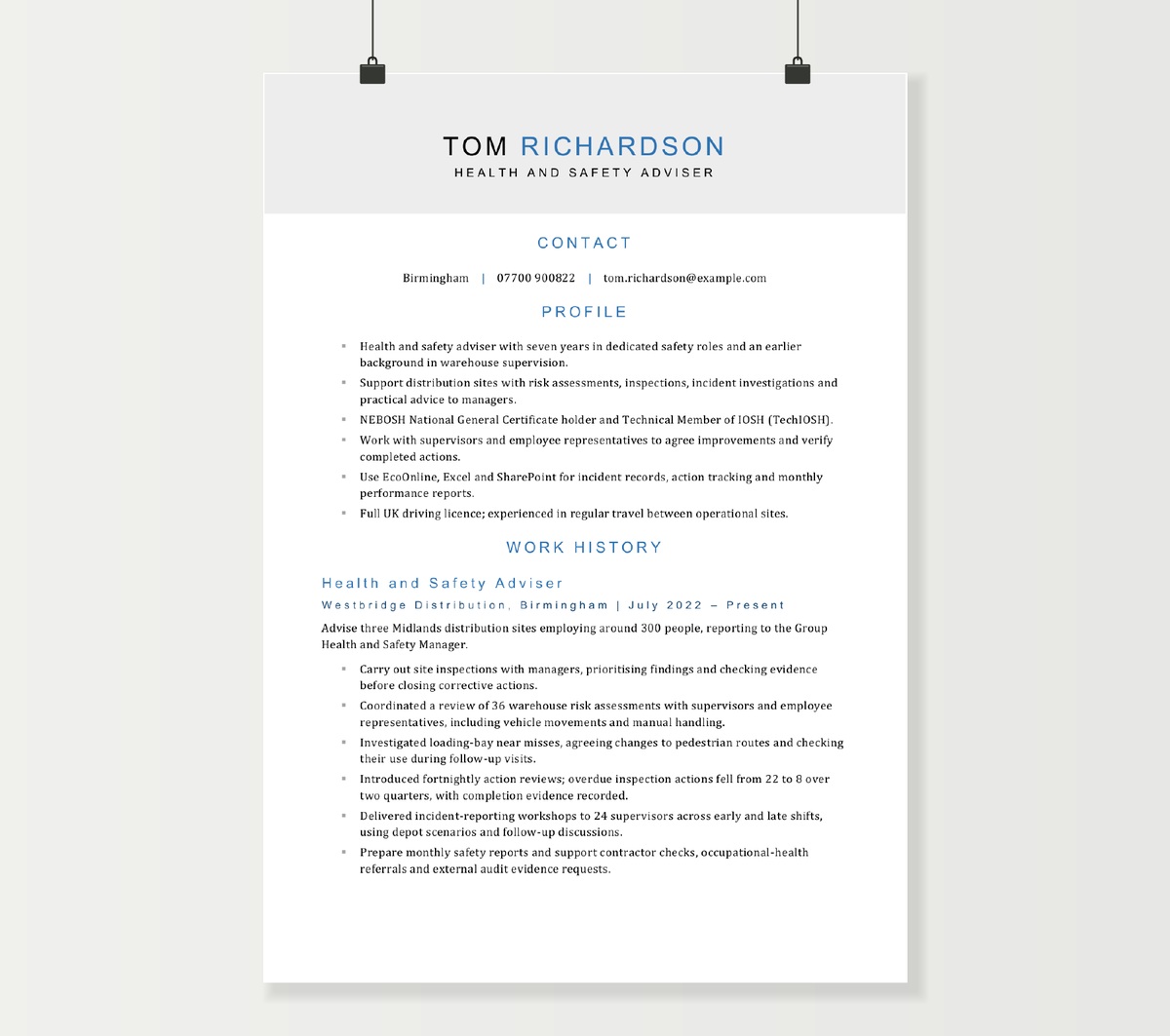
This health and safety adviser CV template follows a safety professional who moved from warehouse supervision into a dedicated advisory role. The Word example combines qualifications with evidence of site inspections, incident investigations, action tracking and work with operational managers. The guide helps applicants present their experience for adviser and advisor vacancies across different working environments.
Filename: FreeCVDownload_Health_and_Safety_Adviser.docx
Content of this CV template
Tom Richardson
Health and Safety Adviser
Contact
Birmingham | 07700 900822 | [email protected]
Profile
- Health and safety adviser with seven years in dedicated safety roles and an earlier background in warehouse supervision.
- Support distribution sites with risk assessments, inspections, incident investigations and practical advice to managers.
- NEBOSH National General Certificate holder and Technical Member of IOSH (TechIOSH).
- Work with supervisors and employee representatives to agree improvements and verify completed actions.
- Use EcoOnline, Excel and SharePoint for incident records, action tracking and monthly performance reports.
- Full UK driving licence; experienced in regular travel between operational sites.
Work history
Health and Safety Adviser
Westbridge Distribution, Birmingham | July 2022 – Present
Advise three Midlands distribution sites employing around 300 people, reporting to the Group Health and Safety Manager.
- Carry out site inspections with managers, prioritising findings and checking evidence before closing corrective actions.
- Coordinated a review of 36 warehouse risk assessments with supervisors and employee representatives, including vehicle movements and manual handling.
- Investigated loading-bay near misses, agreeing changes to pedestrian routes and checking their use during follow-up visits.
- Introduced fortnightly action reviews; overdue inspection actions fell from 22 to 8 over two quarters, with completion evidence recorded.
- Delivered incident-reporting workshops to 24 supervisors across early and late shifts, using depot scenarios and follow-up discussions.
- Prepare monthly safety reports and support contractor checks, occupational-health referrals and external audit evidence requests.
Health and Safety Coordinator
Central Vale Logistics, Birmingham | March 2019 – June 2022
Supported the Safety Manager at a distribution centre with 180 employees.
- Maintained incident records, training schedules and inspection actions, following up missing information with shift leaders.
- Assisted investigations by gathering photographs, statements and relevant training records.
- Updated COSHH assessment records with managers and coordinated reviews following product changes.
- Organised refresher training for 42 colleagues and maintained records for internal audits.
Warehouse Team Leader
Central Vale Logistics, Birmingham | Sep 2015 – Feb 2019
Supervised a team of 12 in goods-in and despatch.
- Led shift briefings, checked work areas and reported hazards and equipment defects.
- Helped introduce a clearer handover for damaged pallets and isolated equipment.
Qualifications and development
NEBOSH National General Certificate
In Occupational Health and Safety | 2018
Membership and further training
Technical Member of IOSH (TechIOSH), 2020–present; ISO 45001 internal auditor training (2023); incident investigation workshop (2024); 3 A levels (2015).
Hobbies and interests
I enjoy cycling, gardening and watching live cricket.
How to write a health and safety adviser CV
A strong health and safety adviser CV connects professional knowledge with changes in the workplace. Qualifications establish part of your background; your experience shows how you identify significant risks, work with the people who manage them and follow improvements through. Give the employer evidence of advice that has been understood and acted on.
The working environment matters. A distribution depot, university workshop, highway project and local authority service have different hazards, stakeholders and priorities. Start by identifying which parts of your experience are most relevant to the vacancy, then use those to shape your profile and the order of your employment bullets.
Establish your professional background and operating context
Your opening should make your level and field of experience clear. Include your main health and safety qualification, current professional membership where relevant, and the kind of organisation or sites you support. Two or three sentences can establish whether you are a developing coordinator, an experienced site adviser or a practitioner supporting several locations.
Under each job title, explain the scale of your remit. The number and type of sites, workforce size, shift arrangements, travel and reporting line can all help. Select the details that affect your work: advising three distribution centres has different demands from being based on one construction project.
Also show how you work with the organisation. An adviser may report to a group safety manager while supporting local managers, supervisors and employee representatives. That relationship explains how you influence decisions and where your recommendations go. In the example CV, the site and workforce context makes the subsequent inspection and training achievements easier to assess.
Turn risk-assessment experience into useful evidence
“Carried out risk assessments” leaves most of the work unexplained. Identify the relevant activities or hazards and your contribution: leading a review, working with operational teams, checking an assessment after a change, or helping managers develop workable controls. Include the action or improvement that followed where it adds value.
For a warehouse role, vehicle movements, manual handling and contractor activity may be central. In manufacturing, machinery, hazardous substances, noise or maintenance work may be more relevant. In education, laboratories, workshops, fieldwork and public access can change the emphasis. Choose examples that help the reader recognise experience applicable to their own workplace.
A useful bullet might explain that you coordinated a review with supervisors and employee representatives, agreed changes and returned to check implementation. The strength lies in the connection between assessment and workplace action. If you supported a specialist assessment, describe the information, coordination or follow-up you contributed.
Show what happened after inspections and audits
Inspection totals establish activity, but employers also want to know how findings were handled. Describe how you prioritised issues, agreed owners and timescales, recorded actions and checked completion. Examples of a recurring finding being resolved are particularly useful because they show persistence and judgement.
Distinguish workplace inspections, internal management-system audits and support for external audits. Name ISO 45001 where you have relevant experience, then state the task: conducting internal audits, maintaining evidence, tracking nonconformities or contributing to a management review. If your remit includes environmental management, give the corresponding ISO 14001 work its own clear description.
In the example CV, fortnightly reviews help reduce overdue inspection actions from 22 to 8 over two quarters, with evidence recorded before closure. This shows both progress and the basis on which it was measured. A simple statement about “improving compliance” would convey much less.
Present investigations as a chain of evidence and learning
Explain the level of investigation you have undertaken. Gathering records and statements, supporting a lead investigator and leading an investigation are all useful experience at different stages of a career. State your role and the types of events involved, such as near misses, equipment incidents or manual-handling injuries.
Then give the reader the outcome of the work. You might have identified an inconsistent handover, contributed to a revised procedure, agreed a physical change or helped managers communicate lessons to other sites. Include follow-up where you checked whether the action had been put into practice.
Keep the example at a professional level: the relevant circumstances, your analysis or contribution, and the resulting change. This leaves room for the substance of your work without needing personal details about the people involved. If you supported RIDDOR reporting, describe the reporting or record-management task and the person or team you worked with.
Include occupational health risks where they form part of your remit
Health and safety experience can extend well beyond accidents. Relevant evidence might concern exposure controls, COSHH reviews, noise, display-screen equipment, manual handling, occupational-health coordination or work-related stress initiatives. Show the part you played and the colleagues or specialists involved.
For example, coordinating a programme of health-surveillance appointments, updating an exposure record or following up workplace recommendations demonstrates different experience from providing clinical advice. Precise wording lets the employer see how you contributed to the wider process.
Choose one or two examples that reflect the vacancy. A manufacturing employer may place more weight on exposure-related work, while an organisation with a dispersed office workforce may be interested in your experience supporting managers with workstation or wellbeing issues.
Demonstrate influence through specific working relationships
An adviser often achieves change through people whose priorities are operational, commercial or service-focused. Show how you worked with them. A useful example could involve agreeing a practical improvement with a production manager, consulting employee representatives, helping a supervisor understand a finding or presenting a decision to senior leaders.
Training is another opportunity to demonstrate this. Name the audience, subject and delivery context: supervisor incident-reporting workshops, contractor inductions or toolbox talks across shifts. Include the reach and any useful follow-up, such as a discussion, observation or change in the quality of records. Attendance figures show scale; the follow-up explains how you checked understanding or application.
For public-sector or university vacancies, bring out experience with varied services, professional specialists and employee representatives. For contractor-heavy environments, explain how you worked with project teams, reviewed documentation and followed up site issues. These details make communication skills tangible.
Select performance measures with enough context
Useful health and safety results include completion of priority actions, reduction in repeat findings, timely reviews, improved reporting quality and coverage of relevant training. They can show the effect of your work even where incident numbers are small or several teams contributed to the outcome.
If you use accident or injury rates, include the period, scope and basis of comparison. A rate per hours worked and a raw number of incidents describe different things. The same applies to a reduction across one site and a result covering an entire group. Brief context makes the evidence easier to interpret.
More near-miss reports can reflect better engagement with reporting, so explain the improvement you were pursuing. You might describe increased reporting alongside quicker review, better information or completed corrective actions. This tells a fuller story than treating every decrease in reported events as the same kind of success.
Make qualifications, membership and development easy to find
Give the full qualification title and award date. A NEBOSH National General Certificate, a diploma and a specialist construction or fire qualification provide different information. If you are studying, state the course and current stage, with an expected completion date where you have one.
List professional membership separately, using your current grade and post-nominals. TechIOSH, CertIOSH and CMIOSH communicate different membership levels. Keeping this separate from the qualification makes both straightforward for the employer to assess. Selected recent development can then show how you have extended your knowledge, such as investigation training, internal-auditor training or a course relevant to the vacancy’s main risks.
For an experienced applicant, this section can follow employment history, with the key credential also visible in the profile. For someone seeking a first dedicated safety role, qualifications and relevant practical work may deserve an earlier position.
Explain an operational route into health and safety
Supervisory, facilities, engineering and operational roles can provide strong foundations. Highlight safety responsibilities that required you to do something identifiable: leading briefings, contributing to assessments, organising training, investigating defects or following up inspection actions. Place these within the job where they occurred so the reader can see the context and duration.
A recent qualification becomes more persuasive when paired with that practical evidence. Course-based assessment work can also be included in a short relevant-project section, with the setting and your contribution clearly described. As dedicated advisory experience grows, it should take more space than earlier general operational duties.
If you are moving from a supervisory role, the warehouse manager example illustrates how operational scope can be presented. For a role combining workplace services and safety coordination, the facilities manager CV may help you decide how to balance the two areas.
Tailor specialist experience to the vacancy
Construction-related posts may need evidence of CDM work, RAMS review, permits, contractor coordination or particular project environments. Describe your contribution and the project context. These activities are more useful than a list of regulations without accompanying experience.
For a general adviser vacancy, focus on the risks and responsibilities that recur in that organisation. Include digital systems where they support the work: incident recording, action tracking, document control, dashboards or reports used by managers. A final read should leave the employer with a clear picture of the environments you understand, the advice you can provide and the evidence that your work leads to action.
Health and Safety Adviser CV FAQs
Both spellings are used by UK employers. Use the vacancy's spelling in your target-role heading and keep your previous job titles as they were. The substance of your safety experience matters more than the variation. There is no need to prepare separate CVs solely for the two spellings.
Requirements vary with the role's level, risks and responsibilities. Some adviser vacancies accept a relevant certificate and practical experience, while others ask for a diploma or equivalent qualification. Present your exact award and experience against the stated criteria. A qualification requirement in a vacancy is distinct from a blanket legal requirement applying to every safety adviser.
Qualifications and professional membership are separate. A relevant qualification can meet the academic part of a membership route, with experience and other requirements also applying. On your CV, list the qualification under education or professional development and show the membership grade you currently hold separately. This gives an employer a clear view of both.
Yes, where the vacancy's requirements match your qualifications and experience. Explain the safety responsibilities within your operational job, how regularly you carried them out and the people you supported. A supervisor who helped review assessments, led briefings and followed up findings has useful evidence to present. Dedicated coordinator or developing-adviser roles can provide a natural next step.
Give each project's dates, working environment and purpose, followed by your main contribution. Useful context includes the project stage, principal risks, contractor interfaces and the handover you completed. If you worked through one consultancy or agency, a single employer heading with dated project entries can keep the history readable while preserving the range of experience.
Use the CV to make your career, qualifications and strongest examples easy to scan. In the statement, address the person specification with fuller examples of the required work, such as influencing a manager, investigating an incident or delivering training. The same experience can appear in both, with the statement providing the context and reasoning that the shorter CV bullet cannot contain.




