
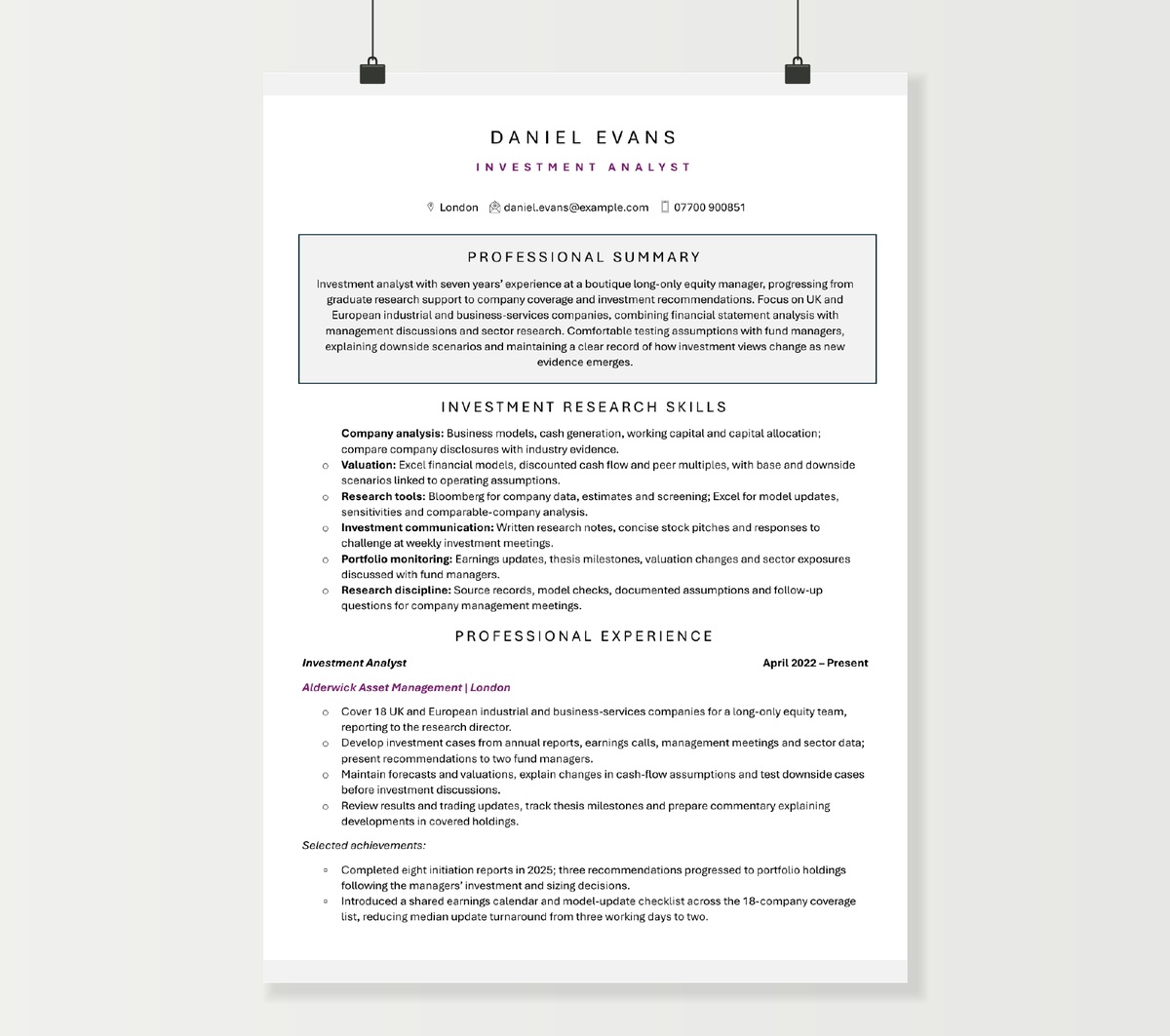
This investment analyst CV template follows a graduate research trainee into a role covering UK and European equities. The Word example connects company analysis and financial modelling with recommendations, portfolio monitoring and practical research improvements. Use the guide to present your own investment specialism, whether you research securities, assess external managers or support portfolio decisions.
Filename: FreeCVDownload_Investment_Analyst.docx
Content of this CV template
Daniel Evans
INVESTMENT ANALYST
London | [email protected] | 07700 900851
Professional summary
Investment analyst with seven years’ experience at a boutique long-only equity manager, progressing from graduate research support to company coverage and investment recommendations. Focus on UK and European industrial and business-services companies, combining financial statement analysis with management discussions and sector research. Comfortable testing assumptions with fund managers, explaining downside scenarios and maintaining a clear record of how investment views change as new evidence emerges.
Investment research skills
- Company analysis: Business models, cash generation, working capital and capital allocation; compare company disclosures with industry evidence.
- Valuation: Excel financial models, discounted cash flow and peer multiples, with base and downside scenarios linked to operating assumptions.
- Research tools: Bloomberg for company data, estimates and screening; Excel for model updates, sensitivities and comparable-company analysis.
- Investment communication: Written research notes, concise stock pitches and responses to challenge at weekly investment meetings.
- Portfolio monitoring: Earnings updates, thesis milestones, valuation changes and sector exposures discussed with fund managers.
- Research discipline: Source records, model checks, documented assumptions and follow-up questions for company management meetings.
Professional experience
Investment Analyst | April 2022 – Present
Alderwick Asset Management | London
- Cover 18 UK and European industrial and business-services companies for a long-only equity team, reporting to the research director.
- Develop investment cases from annual reports, earnings calls, management meetings and sector data; present recommendations to two fund managers.
- Maintain forecasts and valuations, explain changes in cash-flow assumptions and test downside cases before investment discussions.
- Review results and trading updates, track thesis milestones and prepare commentary explaining developments in covered holdings.
Selected achievements:
- Completed eight initiation reports in 2025; three recommendations progressed to portfolio holdings following the managers’ investment and sizing decisions.
- Introduced a shared earnings calendar and model-update checklist across the 18-company coverage list, reducing median update turnaround from three working days to two.
Graduate Research Analyst | September 2019 – March 2022
Alderwick Asset Management | London
- Supported senior analysts with company research, financial data collection and preparation for investment meetings across UK equities.
- Updated financial histories and peer comparisons in Excel, reconciling reported figures with source accounts and documenting adjustments.
- Summarised earnings calls and industry developments, highlighting questions for follow-up research and management discussions.
- Worked with operations colleagues to check holdings data used in monthly sector-exposure reports and resolve classification discrepancies.
Selected achievements:
- Built a comparable-company workbook covering 24 businesses, bringing valuation dates, source references and sector classifications into one reviewable file.
- Progressed to independent coverage of four companies under senior review before promotion to Investment Analyst in April 2022.
Qualifications & development
BSc (Hons) Economics and Finance, 2:1 – University of Bristol, 2019
Investment Management Certificate (IMC) – Completed 2020
CFA Program – Passed Level II, 2024
Financial modelling development – Employer training, 2025
Additional information
- Recent development: Internal workshops on cash-flow forecasting, accounting adjustments and investment research presentation during 2025–26.
- Team contribution: Help new graduate analysts check model inputs and prepare their first company research summaries.
- Interests: Playing five-a-side football, hill walking and cooking.
How to write an investment analyst CV
An investment analyst CV should make your judgement visible. A reader needs to understand what you research, how you reach a view and what happens to that view inside an investment process. Financial models and market terminals matter because they support that work. Your strongest evidence connects them to a recommendation, a better understanding of risk or a decision about a portfolio.
Define the investment role you are applying for
Investment analyst covers several different jobs. A fundamental equity team may want company coverage and stock ideas. An institutional consultant may need manager research and asset-allocation analysis. An insurer may be looking for portfolio monitoring, investment reporting and reliable implementation. Start by identifying which of those responsibilities drives the vacancy, then bring the matching part of your experience towards the top.
For a research role, a useful profile might identify your asset class, sector or regional coverage, investment approach and level of responsibility. “Equity analyst covering European industrial companies, with experience developing investment cases and presenting recommendations to long-only fund managers” gives the reader a much clearer starting point than “analytical finance professional with a passion for markets”. Add a particular strength if the rest of the CV supports it, such as cash-flow analysis, credit assessment or external-manager due diligence.
The example above concentrates on listed equities. Its structure also works for other investment roles, but the substance should change with your remit. A fund-selection analyst would put manager assessment and monitoring ahead of company valuation; a portfolio analyst might lead with attribution, exposure analysis and reporting.
Give each role a clear coverage and responsibility statement
At the start of an employment entry, explain the investment setting in one or two lines. Useful details include the strategy, asset class, geography, sectors, number of companies or managers covered, and who used your research. This gives later achievements a scale and a purpose.
Then distinguish the stages you handled. Maintaining forecasts, initiating coverage, recommending a position and taking a portfolio decision are different contributions. Verbs such as researched, modelled, recommended, challenged, monitored and presented let a reader follow your role precisely. If you gained responsibility over time, show the change: moving from updating models to owning company coverage is meaningful progression even when your job title stayed the same.
For a senior analyst, include how you set research priorities, developed a sector view, coached colleagues or coordinated work across a team. A long list of companies carries less information than an explanation of the coverage you owned and the decisions it supported.
Turn research experience into a compact investment case
Select two or three pieces of work that show how you think. A useful CV entry can move through the investment question, the evidence you examined, your conclusion and its use. You have only a few lines, so choose the assumption or finding that made the work distinctive.
For example: “Reassessed a distributor’s cash conversion using segment accounts and working-capital trends; revised the downside case and presented a lower valuation range ahead of the portfolio review.” This shows accounting analysis, modelling and communication in a single piece of evidence. It also gives an interviewer something concrete to explore.
Other worthwhile cases might involve changing your view after a company update, identifying a risk hidden by headline earnings, comparing an issuer with sector peers or challenging a manager’s explanation of performance. An outcome can be a recommendation to wait, further diligence, a monitoring trigger or a revised assumption. The CV benefits from showing the quality of the decision process as well as ideas that reached a portfolio.
Show what your modelling and valuation skills are used for
“Financial modelling” is broad. Explain whether you built or maintained integrated forecasts, company cash-flow models, credit models, property appraisals or portfolio scenarios. Name the valuation approaches relevant to your work, then connect them to operating assumptions and the research question. A short description of revenue drivers, margins, capital expenditure or financing assumptions is more useful than a long list of formula names.
For equity research, financial-statement analysis, earnings quality, cash generation and capital allocation can be strong differentiators. For credit roles, your examples may centre on leverage, liquidity, debt terms and repayment capacity. Private-market or real-asset work may involve transaction assumptions, asset-level forecasts and investment committee papers. Present the version you actually use in your employment or project examples.
Model quality also deserves a place where it was a substantive contribution. Source checks, a consistent treatment of accounting adjustments, more usable sensitivities or a clearer review trail can improve an investment team’s work. Describe the improvement and its benefit to the analyst or decision-maker, rather than turning the CV into a modelling checklist.
Describe investment impact with enough context to interpret it
Investment outcomes often involve several people and market movements. The most persuasive achievement identifies your contribution and the basis of the result. In the example CV, eight initiation reports and three recommendations progressing to holdings show research output and adoption; the portfolio managers’ investment and sizing decisions remain clear.
If performance attribution is a relevant, available measure, state the period, portfolio or coverage basis, and what the number represents. A stock’s price movement, its contribution to portfolio return and a strategy’s return relative to a benchmark are different measures. A reader should be able to tell which one appears in your CV without having to reconstruct it.
Useful results also include expanding coverage, improving the turnaround of earnings updates, identifying an exposure for review, resolving portfolio-data discrepancies or making committee materials easier to use. Quantify the scope or change where it adds meaning. The number of managers reviewed alongside the depth of your diligence tells more than an isolated claim that research was “high quality”.
Adapt the evidence for manager research and portfolio analysis
For manager-research applications, describe the strategies you assessed and the work behind a recommendation. Relevant evidence may include meeting investment teams, examining a manager’s process and capacity, interpreting performance and risk, reviewing changes in personnel, and maintaining a monitoring view. Explain which part of a due-diligence report you owned and how it informed selection or continued oversight.
For portfolio-analysis roles, make the portfolio setting and audience clear. Performance attribution, liquidity analysis, exposure monitoring and scenario reporting become stronger CV evidence when linked to a fund manager, investment committee or institutional client. Where your job includes reconciliation or implementation, show how that work made the investment information dependable.
Insurance investment roles can require close work with risk, actuarial and finance teams. Put relevant mandate controls, asset-liability analysis or regulatory reporting experience beside the actual report or process you supported. Your risk analyst CV evidence may be useful when moving towards this type of investment work.
Make communication part of your analytical evidence
Investment teams need a view they can question and act on. Show the formats you used: initiation reports, investment committee papers, short research notes, stock pitches, manager reviews or client commentary. Identify the audience and the purpose rather than adding “excellent presentation skills” to a separate list.
An entry about presenting a thesis to fund managers can mention the debate it prompted or the assumption you subsequently tested. A client-facing analyst may highlight explaining portfolio positioning or the causes of performance. Someone working with company management can show how meeting preparation and follow-up questions advanced the research. These examples demonstrate communication through investment work.
Keep the technical skills section selective
Group tools by their use. Excel might sit beside forecasting and sensitivity analysis; Bloomberg, FactSet or another data platform beside screening, company information or portfolio analytics. Include the tools a prospective team uses when you have relevant experience, and make your strongest capabilities visible again in an employment or project entry.
Python, R and SQL deserve space when they contributed to your analysis or workflow. “Used Python to combine earnings data and flag changes for analyst review” gives a clearer picture than “Python: advanced”. For a fundamental research vacancy, programming may be supporting evidence. For a quantitative or data-intensive investment role, the research methods, datasets, validation and implementation may warrant a more prominent section.
Present qualifications as part of a coherent development story
Include your degree, institution and result where relevant, followed by investment qualifications and current study. State completed CFA Program levels and dates clearly. Keep the charterholder designation distinct from exam progress, and describe an active exam candidacy by its current level. An IMC, accounting qualification or other relevant professional award can help explain the technical foundation you bring to the role.
Experienced applicants can keep education compact and give more space to investment decisions and coverage. Graduates may place education higher, including a dissertation or project that demonstrates financial analysis, quantitative reasoning or economic research. Choose modules only when they add evidence the degree title does not already convey. A long catalogue of short courses is less helpful than a relevant qualification plus an example of applying the learning.
Use projects and adjacent experience to establish your direction
An entry-level CV can use an investment society project, dissertation, internship or independently developed research note to show the same reasoning expected in professional work. Give the question, source material, analytical approach, conclusion and your contribution. For a group stock pitch, identify the part you handled, such as modelling, industry research or presentation.
For a move from accountancy, transaction work or corporate finance, select experience that reveals understanding of business performance, cash flow, valuation and management decisions. Add focused investment research evidence to explain the move. Our financial analyst example can help with the presentation of forecasting and commercial analysis before you bring the investment relevance forward.
Sell-side analysts moving into a buy-side team can emphasise the investment implications of their coverage: differentiated conclusions, changing theses, catalysts, downside and portfolio relevance. Operations or reporting analysts can bring forward research projects and analytical ownership alongside their knowledge of holdings, investment data and controls. Let the CV show the bridge between your experience and the new role through specific work.
Investment Analyst CV FAQs
Follow the application instructions first. Where a pitch is requested, send it as a separate, clearly dated document so the CV remains easy to scan. If supporting material is optional, a short line offering a research sample is usually enough. A focused pitch with a clear thesis, valuation, downside and relevant evidence is more useful than a large folder of market commentary.
It can establish interest early in your career, particularly when it led to a structured research project or a thoughtful investment journal. Describe the analytical work and what you followed up. A personal account balance or a short period of returns gives an employer little comparable evidence. Once you have substantial professional research experience, that will usually deserve the space.
Yes, if it demonstrates useful judgement. Explain the research question, your conclusion and what the team did next, such as requesting further diligence or adding a monitoring trigger. A well-reasoned decision to pass on an investment can be a strong discussion point. Choose work you can explain in depth, including how you responded to challenge.
A fund or mandate size can provide context, especially for portfolio, institutional or operational roles. Introduce it as the scale of the strategy or team you supported, then describe your own coverage or responsibilities separately. If an exact figure is unsuitable for sharing, a broad description of the investment setting can provide sufficient context.
Use a concise description of the sector, research question, analytical approach and decision supported. An anonymised case can still show considerable depth. For an interview sample, independently prepared work using public information gives you material you can discuss freely; keep it separate from employer research and label its date and purpose.
Use the employer’s specified format where there is one. A graduate application may fit well on one page, while an experienced analyst often needs two to explain coverage, selected investment work and progression. A transaction list, detailed track record or research sample can be a separate document when requested. The main CV should make the strongest evidence easy to find.




