
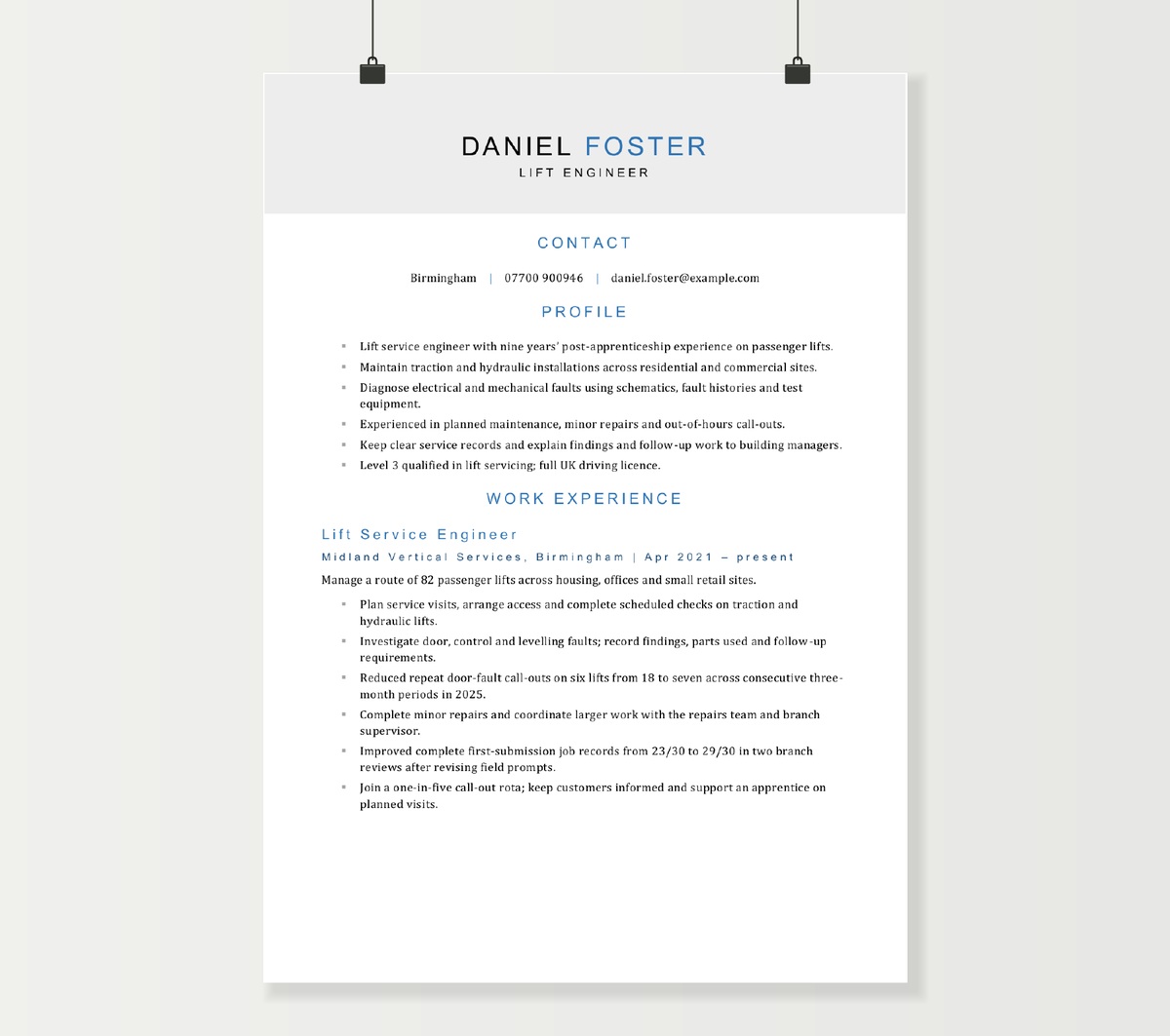
This lift engineer CV template follows an apprenticeship through service engineering to responsibility for a mixed passenger-lift route. The Word example combines technical experience with fault records, customer communication and reliability improvements. The guide covers applications for servicing, repair, installation, modernisation and technician roles.
Filename: FreeCVDownload_Lift_Engineer.docx
Content of this CV template
Daniel Foster
Lift Engineer
Contact
Birmingham | 07700 900946 | [email protected]
Profile
- Lift service engineer with nine years’ post-apprenticeship experience on passenger lifts.
- Maintain traction and hydraulic installations across residential and commercial sites.
- Diagnose electrical and mechanical faults using schematics, fault histories and test equipment.
- Experienced in planned maintenance, minor repairs and out-of-hours call-outs.
- Keep clear service records and explain findings and follow-up work to building managers.
- Level 3 qualified in lift servicing; full UK driving licence.
Work experience
Lift Service Engineer
Midland Vertical Services, Birmingham | Apr 2021 – present
Manage a route of 82 passenger lifts across housing, offices and small retail sites.
- Plan service visits, arrange access and complete scheduled checks on traction and hydraulic lifts.
- Investigate door, control and levelling faults; record findings, parts used and follow-up requirements.
- Reduced repeat door-fault call-outs on six lifts from 18 to seven across consecutive three-month periods in 2025.
- Complete minor repairs and coordinate larger work with the repairs team and branch supervisor.
- Improved complete first-submission job records from 23/30 to 29/30 in two branch reviews after revising field prompts.
- Join a one-in-five call-out rota; keep customers informed and support an apprentice on planned visits.
Lift Service Engineer
Central Counties Lifts, Birmingham | Sep 2017 – Mar 2021
Maintained a mixed service route following completion of the company’s apprenticeship.
- Carried out routine servicing, attended breakdowns and escalated complex faults to a technician.
- Replaced approved door components and supported planned repairs under agreed work instructions.
- Prepared defect notes and parts requests, with photographs and equipment references.
- Helped standardise access notes for 35 sites, reducing avoidable return visits caused by missing entry information.
Apprentice Lift Engineer
Central Counties Lifts | Sep 2013 – Aug 2017
Completed supervised service, repair and installation placements alongside technical study.
- Assisted engineers with planned maintenance, component checks and accurate service documentation.
- Developed electrical drawing, mechanical fitting and fault-finding skills through assessed workplace tasks.
Qualifications & development
EAL Level 3 NVQ Diploma in Engineering Maintenance
Lift Servicing pathway | Apprenticeship completed 2017
Technical and safety training
Employer training: lift rescue refresher, 2026; safe isolation refresher, 2026; door systems diagnostics, 2024
Interests
Hill walking, cooking and restoring a classic motorbike.
How to write a lift engineer CV
A lift engineer CV should tell an employer which equipment you work on, what you can take responsibility for and how you manage work on occupied customer sites. Servicing a route, delivering a modernisation project and supporting complex fault diagnosis involve different evidence, even when the job titles sound similar.
Put your relevant lift qualification and main area of experience near the top. Then use the employment section to show the equipment, technical decisions, records and customer responsibilities behind that description.
Make your specialism clear at the first read
Describe your main work as service and call-out, repairs, installation, modernisation or technical support. If your role combines several areas, indicate the balance. “Service engineer covering a mixed passenger-lift route, with minor repairs and call-out duties” is more informative than “experienced in all aspects of lift engineering”.
Identify relevant equipment: traction or hydraulic lifts, passenger or goods installations, machine-room-less equipment, platform lifts or other systems. Include manufacturers and controller types selectively where your familiarity is likely to matter to the vacancy. A few well-supported examples are easier to assess than a long list without context.
The example CV is deliberately centred on servicing. Daniel’s installation placement appears in his apprenticeship history, while his current route, diagnosis and customer work carry the application. An installation specialist would use that space differently.
Describe a service route as a responsibility
For service roles, give the size and type of portfolio, your geographical patch and the customer settings. A route spanning housing, offices and retail sites brings different access arrangements and service pressures from a single large hospital or transport contract.
Explain how you organise planned visits alongside reactive work. Useful evidence includes arranging access, identifying follow-on repairs, keeping outstanding work visible and coordinating with a dispatcher, supervisor or repairs team. State whether you manage the route independently or provide cover within a wider team.
Include the call-out arrangement where relevant. Experience on a one-in-five rota, for example, gives a practical picture of the role. The stronger CV evidence then concerns diagnosis, escalation, communication and the records left for the next engineer.
Service completion and repeat-call measures can show route performance. Make their scope clear: the period, the group of lifts and your contribution. Where a branch result reflects several engineers’ work, describe the improvement you helped deliver.
Give fault-finding evidence a beginning and an outcome
A technical bullet should identify the kind of problem, the information you used and the result. Door faults, intermittent control issues, levelling problems and hydraulic faults are more useful signals than a general statement about problem-solving.
You can explain that you used schematics, event histories, test results or repeated site observations to establish the cause, then describe the repair, referral or follow-up. There is no need to include a troubleshooting procedure. The employer needs evidence of your reasoning and the level of work you handle.
Distinguish independent diagnosis from support work with a technician. Both belong on a CV, and the wording makes progression visible. For senior roles, include difficult fault investigations, technical advice to other engineers and the quality of the reports you produced.
Daniel’s repeat door-fault example gives a defined group of six lifts and two three-month periods. That is a useful reliability result because the reader can see the scale and comparison. Other examples might concern fewer repeat visits, better parts identification or a recurring fault resolved after a coordinated investigation.
For repairs and modernisation, show what you delivered
Repair and modernisation applications benefit from selected project evidence. State the equipment and scope, your role in the team, the principal work packages and your contribution to completion or handover.
Relevant details could include door equipment, controllers, drives, hydraulic components or other assemblies within your experience. Explain whether you led the work, completed a defined part of it or supported a specialist. The project description should make the level of responsibility clear without becoming a parts catalogue.
Include coordination with the project manager, client, other trades and testing engineer. Working in an occupied building can provide strong evidence of planning: access windows, agreed shutdowns, keeping work areas available and communicating progress all affect delivery.
Results may include a completed programme, resolved snag items, an effective handover or reduced disruption during an agreed shutdown. Project size and number of units help establish scale, while the account of your work explains your capability.
For installation, follow the job through to handover
Installation experience should cover the stages you actually undertake. Employers may look for mechanical and electrical installation, interpretation of drawings, coordination of materials, quality checks and support for testing and commissioning.
Identify the setting when it affects the work: new-build developments, refurbishment, transport infrastructure or constrained existing shafts. Site requirements and coordination responsibilities can be as important to the application as the equipment itself.
A lead installer should show team supervision, allocation of work, progress reporting and management of technical queries. Someone supporting commissioning can specify the preparation, checks and documentation they contributed. This gives the reader a clear view of the handover between installation and testing responsibilities.
Present safety and examination experience precisely
Practical safety responsibilities belong in the employment history: following approved work methods, completing site assessments, controlling access, recording defects and escalating equipment concerns. List relevant recent training separately, including the provider or employer and date.
Distinguish routine maintenance, commissioning tests and statutory thorough examination in your wording. A service engineer may carry out remedial work following an examination report, provide equipment records or support access for an examiner. Those are valuable contributions and can be described directly.
If thorough examination is part of your own professional role, explain the equipment scope, competence and reporting responsibility. HSE’s guidance on thorough examination sets out the distinction from maintenance and the examiner’s independence. A CV only needs enough detail to establish the work you perform.
Show the customer-facing part of engineering
Lift engineers often represent the service company on site. Use evidence of keeping building managers informed, explaining the practical effect of a fault, arranging a return visit or supplying a clear account of the work completed.
Good documentation supports the technical work. Mention digital service systems, site logs, equipment histories, parts requests and repair recommendations where you use them. An improvement to record completeness or the quality of handover notes can make a worthwhile achievement.
For technician or survey work, include reports that led to a repair plan, a modernisation proposal or a decision about further investigation. Explain the audience and the decision supported. A detailed report matters because someone could use it.
List qualifications with the pathway and status
Give the full qualification title, level and relevant pathway, followed by the completion year. “Level 3 NVQ Diploma in Engineering Maintenance — Lift Servicing” tells a recruiter more than “NVQ 3”. Older recognised routes can be listed under their original award titles.
For an award in progress, include the provider, stage and expected completion date where known. Employers considering developing engineers can then assess both your current capability and the training still under way.
Testing and advanced technician vacancies may place different weight on Level 4 qualifications and technical experience. Bring the specific award and the corresponding work together. Manufacturer training, relevant site credentials and recent safety development can follow in a compact section.
Include your driving licence and working area where travel is part of the vacancy. An apprentice application can give more space to relevant technical study, supervised workplace tasks and practical projects; an experienced engineer can use that space for equipment expertise and responsibility for a route or project.
Engineers entering from another maintenance field should make the transferable electrical, mechanical and customer-site experience easy to find, alongside any lift-specific development. The maintenance engineer CV example offers another way to present that earlier experience. Browse the Word template library for alternative layouts.
Lift Engineer CV FAQs
Lift engineer is the usual UK wording and is a suitable headline for most UK applications. Retain an employer’s official job title in your work history, even if it uses elevator. The equipment and responsibilities beneath it will make the experience clear.
Some skills transfer, including electrical and mechanical diagnosis, customer visits and service documentation. Describe your equipment and qualification pathway clearly, then identify any passenger-lift training or experience. The vacancy’s requirements will indicate whether the employer is recruiting an established passenger-lift engineer or offering a development route.
Use the award’s recorded title, awarding body and completion date. Add a brief description of the service, repair or installation experience it supports. Where an advert expressly accepts a J-module route, this lets the recruiter recognise the qualification without having to infer it from a generic training entry.
Prioritise systems you know well and those relevant to the employer’s portfolio. Put the names alongside the type of work, such as routine servicing, diagnosis or modernisation. A short, meaningful list is more useful than occasional exposure presented with equal weight.
Requirements vary between technical-support and testing posts. Show your complex fault-finding, support for other engineers and technical reporting, then state any Level 4 study separately. Some vacancies offer development towards testing; others require the completed qualification and relevant testing experience at appointment.
A short additional-information line can cover your working area and availability where these are central to the role. More detailed rota or travel arrangements are often better discussed with the recruiter. Keep the main CV focused on the service or project work you can deliver.
Use concrete work outcomes: a recurring fault resolved, a complete set of access records, a well-documented repair handover or support that helped an apprentice progress. State the equipment or project context and your contribution. These examples give an employer useful evidence even when performance figures are held centrally.




