
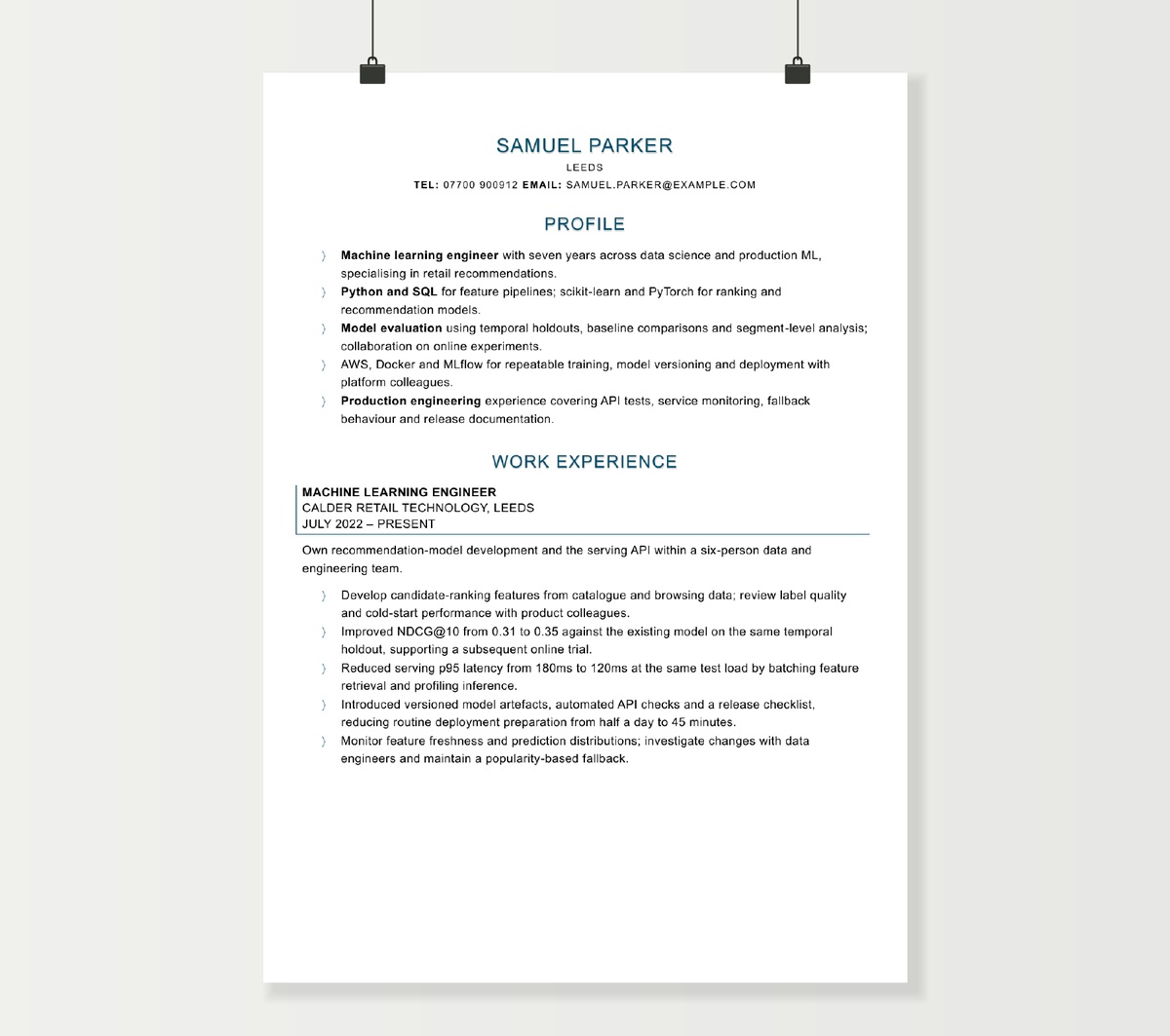
This machine learning engineer CV template follows a data scientist moving into production recommendation systems. The Word example connects model development with evaluation, deployment and service reliability. The guide explains how to present different kinds of ML engineering experience, from a first substantial project to ownership of a live system.
Filename: FreeCVDownload_Machine_Learning_Engineer.docx
Content of this CV template
SAMUEL PARKER
LEEDS
tel: 07700 900912 email: [email protected]
PROFILE
- Machine learning engineer with seven years across data science and production ML, specialising in retail recommendations.
- Python and SQL for feature pipelines; scikit-learn and PyTorch for ranking and recommendation models.
- Model evaluation using temporal holdouts, baseline comparisons and segment-level analysis; collaboration on online experiments.
- AWS, Docker and MLflow for repeatable training, model versioning and deployment with platform colleagues.
- Production engineering experience covering API tests, service monitoring, fallback behaviour and release documentation.
WORK EXPERIENCE
MACHINE LEARNING ENGINEER
CALDER RETAIL TECHNOLOGY, LEEDS
JULY 2022 – PRESENT
Own recommendation-model development and the serving API within a six-person data and engineering team.
- Develop candidate-ranking features from catalogue and browsing data; review label quality and cold-start performance with product colleagues.
- Improved NDCG@10 from 0.31 to 0.35 against the existing model on the same temporal holdout, supporting a subsequent online trial.
- Reduced serving p95 latency from 180ms to 120ms at the same test load by batching feature retrieval and profiling inference.
- Introduced versioned model artefacts, automated API checks and a release checklist, reducing routine deployment preparation from half a day to 45 minutes.
- Monitor feature freshness and prediction distributions; investigate changes with data engineers and maintain a popularity-based fallback.
DATA SCIENTIST
PENNINE STORES GROUP, LEEDS
SEPTEMBER 2019 – JUNE 2022
Developed forecasting and classification models for a regional retail group, working with analysts and software developers.
- Built weekly demand-forecasting experiments in Python and compared performance with seasonal baselines across product categories.
- Prepared SQL training datasets and investigated missing sales records, stock-related distortions and changes in product identifiers.
- Packaged repeatable training runs and documented assumptions so colleagues could reproduce model comparisons.
- Presented forecast errors to buying teams and helped prioritise categories for further investigation.
QUALIFICATIONS & DEVELOPMENT
MSc DATA SCIENCE — MERIT
UNIVERSITY OF LEEDS — 2019
Dissertation: evaluating recommendation models with time-based validation.
BSc (Hons) COMPUTER SCIENCE — 2:1
UNIVERSITY OF YORK — 2018
RECENT PROFESSIONAL DEVELOPMENT
MODEL MONITORING AND PERFORMANCE PROFILING — 2025–2026
INTERESTS
Climbing, live music and making small web apps for friends.
How to write a machine learning engineer CV
A machine learning engineer CV needs to make your contribution to an ML system understandable. A reader should be able to see the problem, the data and modelling work, the engineering involved and what improved. Those elements carry different weight in different roles: one team needs better ranking models, another needs dependable deployment, and another needs faster training across specialised hardware.
Use the vacancy to decide which evidence leads. A long list of frameworks gives less information than a well-chosen account of a system you helped build, evaluate or operate.
Establish the kind of ML engineering you do
Your opening profile should identify your level, the applications you know and the parts of the lifecycle you have handled. Recommendations, forecasting, computer vision, speech and language systems involve different data and evaluation problems. Naming the application gives the reader a useful starting point.
Then make the balance of your work clear. You may concentrate on features, training and model quality; build the services and pipelines around models; or combine both. The example CV introduces Samuel through retail recommendations and then supports that specialism with evidence of evaluation and production engineering.
Follow with a small, organised technical section. Suitable groupings might be modelling and evaluation, data and programming, and deployment and operations. Put the technologies most relevant to the vacancy first. Experience bullets can then establish the depth behind those names.
Turn a model project into a clear account of your work
For each substantial role, identify the system or decision your models supported. “Built machine learning models in Python” leaves the reader guessing; “Developed a product-ranking model for a retail recommendation service” establishes a purpose immediately.
A useful project description connects four things:
- The application and the data available for the decision.
- Your responsibility, including the parts shared with colleagues.
- The modelling or engineering choice that mattered.
- The evidence used to judge the result.
These can fit across two or three bullets rather than a dense paragraph. Include scale where it explains difficulty: the number of items being ranked, training-data volume, request load, update frequency or range of supported products. Choose the measure that affected your work.
Team context also helps. Owning model development in a small product team is different from contributing to a specialist research group or maintaining a shared ML platform. A short scope sentence below the job title can establish that context once.
Make evaluation results interpretable
A model score becomes useful CV evidence when the reader can understand its comparison. Name the relevant metric and baseline, then add the evaluation context that matters. For a ranking model, that might be NDCG at a stated cutoff on a temporal holdout. For a classifier, it might be recall at an agreed precision level. For a forecast, it might be error across a defined group of products.
Samuel’s CV gives the previous and new NDCG@10 values on the same holdout. That describes an offline improvement. The subsequent online trial is a separate stage, which makes the development sequence clear.
When your work reached an A/B test, distinguish the model measure from the product outcome. State the result and the relevant period or population where space allows, and describe your role in the experiment. A change in click-through rate, conversion or user retention needs enough context to be understood alongside the engineering work.
Evaluation can also demonstrate judgement without a winning percentage. You might have identified a weak customer segment, exposed a misleading aggregate score, selected a simpler baseline or helped decide that a model was not ready for release. Describe the decision and its consequence.
Give data quality and feature work proper space
The preparation behind a model often contains some of the strongest engineering evidence. Select a problem that affected training or inference: inconsistent identifiers, unreliable labels, delayed events, missing data, changing schemas or features that were unavailable at prediction time.
Explain what you changed and how it improved the work. A repeatable label-generation process, checks on feature availability or a more dependable training dataset can be substantial achievements. Naming SQL becomes much more informative when the CV shows the datasets and transformations you owned.
Where validation design was central, mention the relevant approach briefly. Time-based splits, grouped evaluation and checks for leakage can demonstrate that you understood the application. The CV needs the reason these choices mattered, rather than a tutorial on implementing them.
Show what made the system usable in production
For roles with production responsibility, describe how the model became a dependable component. Useful evidence includes a serving API, batch scoring pipeline, reproducible training process, automated release checks, versioned artefacts, rollback arrangements or integration with an existing product.
Attach infrastructure names to that work. “Docker for packaging inference services” is clearer than an isolated container-tool entry. The same applies to cloud services, orchestration, experiment tracking and model registries. Explain the parts you configured or maintained and the parts delivered with a platform team.
Performance improvements should carry their operating context. Latency at a stated load, throughput on a fixed hardware configuration, or training time for a defined workload lets the reader understand the comparison. Samuel’s latency result uses the same test load, while his release result measures preparation time. They describe different benefits.
If your work centres on shared platforms, deployment and infrastructure, the DevOps engineer CV example may help you present that operational scope. Keep the ML-specific requirements visible alongside it, such as model versions, feature dependencies and evaluation gates.
Include what happened after deployment
Operating a model produces evidence that an experiment alone cannot. Show how you monitored data freshness, prediction behaviour, service health or model outcomes, and what you did when something changed. A concise account of an investigation can demonstrate both analytical and engineering judgement.
Clarify the response you owned: tracing a feature-pipeline fault, reviewing a shift in the input population, coordinating retraining or introducing a fallback. Monitoring tools are supporting details; the useful evidence is the issue you could detect and the action that followed.
For a model-development role where another team owns deployment, describe the handover and feedback loop instead. Documented evaluation, integration support and investigating live performance can establish your contribution without needing a platform-engineering job description.
Choose technical depth that matches the application
Deep-learning roles may warrant detail about architectures, training approaches, framework work and performance optimisation. Distributed-training positions may need evidence of profiling, bottlenecks, hardware utilisation and collaboration with systems engineers. Tabular modelling roles may put more weight on features, labels and business decisions.
For language-model applications, explain the system you built and the evaluation behind it. Retrieval quality, answer usefulness, latency, cost and operational reliability can each be relevant. A CV entry about retrieval-augmented generation becomes stronger when it identifies the information being retrieved, the evaluation set and the improvement you made.
Organise tools around those activities. A targeted account of retrieval evaluation or fine-tuning is easier to assess than a catalogue of model names and libraries. Give specialist techniques space when they are central to the role you want.
Connect technical decisions with colleagues and users
Describe collaboration at the point where it changed the work. You might have agreed a useful target with a product manager, worked with a data engineer on feature availability, or explained an evaluation trade-off to a team deciding what to release.
Senior applicants can show how they shaped that decision-making: reviewing designs, setting evaluation standards, resolving ownership between teams or helping others develop a system. Include the outcome of mentoring or technical leadership where it is concrete, such as a colleague taking ownership of a service or a shared release process adopted by several teams.
Commercial value can be wider than a headline revenue figure. Lower operating cost, shorter release preparation, more reliable predictions or a better decision about where to invest modelling effort can all be meaningful results.
Use projects to support an early-career application
Choose a small number of projects that demonstrate decisions and a finished piece of work. A strong entry states the application, dataset, baseline, evaluation and your contribution. Where relevant, add how the model was packaged, tested or exposed through an application.
A repository link is most useful when a reviewer can quickly find a clear description, instructions to reproduce a result and an explanation of the evaluation. Highlight one or two substantial projects on the CV and link directly to them. The project should give the reader something specific to discuss at interview.
Software development, data analysis and research experience can all provide a route into ML engineering. Bring forward the relevant evidence: tested Python code, data pipelines, statistical experiments, performance analysis or collaboration on a product. Applicants moving from software engineering can use the software developer CV for ideas on presenting that engineering foundation.
Position qualifications around the evidence they add
List relevant degrees clearly, with institution, award and date. A dissertation or research project deserves a short explanation when its methods or application connect with the vacancy. Publications can support research-oriented roles; link to the most relevant work and make your contribution understandable.
For experienced applicants, substantial recent work will usually need more space than module lists. For graduates, a placement, dissertation and selected project can carry the technical narrative. Certifications and courses are useful supporting information where they explain current platform knowledge or a specific area of development.
The final CV should leave a coherent picture of what you can contribute: the models you understand, the engineering you have delivered and the decisions your work helped a team make.
Machine Learning Engineer CV FAQs
Compare the responsibilities rather than relying on the title. Some ML engineer vacancies concentrate on training and evaluation, while others emphasise production services and infrastructure. Lead with the evidence that matches the work: experimental judgement and model quality for the first, or reliable systems and deployment for the second. Your existing job title can stay unchanged in the employment history.
Requirements vary by role. Research-intensive positions may ask for a doctorate, publications or equivalent research experience, while applied product roles may place greater weight on building and improving systems. Present the strongest relevant evidence from your own route, and give research detail more space when the vacancy makes it central.
Yes, particularly early in your career, when you explain the modelling decisions behind it. Include the task, validation approach, your individual contribution and the result in its competition context. Team size can clarify a shared submission. A brief technical account gives the reader more to assess than a ranking alone.
Describe the application, your responsibility, technical choices and outcomes at an appropriate level of detail. A CV does not need a public repository for every production system. Approved architecture summaries, general performance measures and a separate public project can provide useful discussion material without reproducing the employer’s implementation.
They can, when they led to a useful decision or demonstrated substantial work. Explain the question, how you evaluated the approach and what the team concluded. For example, an experiment may have established that a simpler model met the need more efficiently or identified a data limitation that changed the project’s direction.
Show mathematics through relevant work where possible: an optimisation choice, probabilistic model, loss function or evaluation method that affected the result. Research-focused applications may warrant more detail about theory and derivations. For an applied engineering role, a concise account of the method and its practical consequence is usually easier to assess than a broad list of mathematical topics.
Use a selected projects or contributions section when the work is relevant and substantial. State what you contributed, such as a performance improvement, bug fix, test suite or maintained feature, and link to the specific contribution or project. Sustained maintenance and collaboration can demonstrate engineering depth even when the contribution is not a new modelling technique.




