
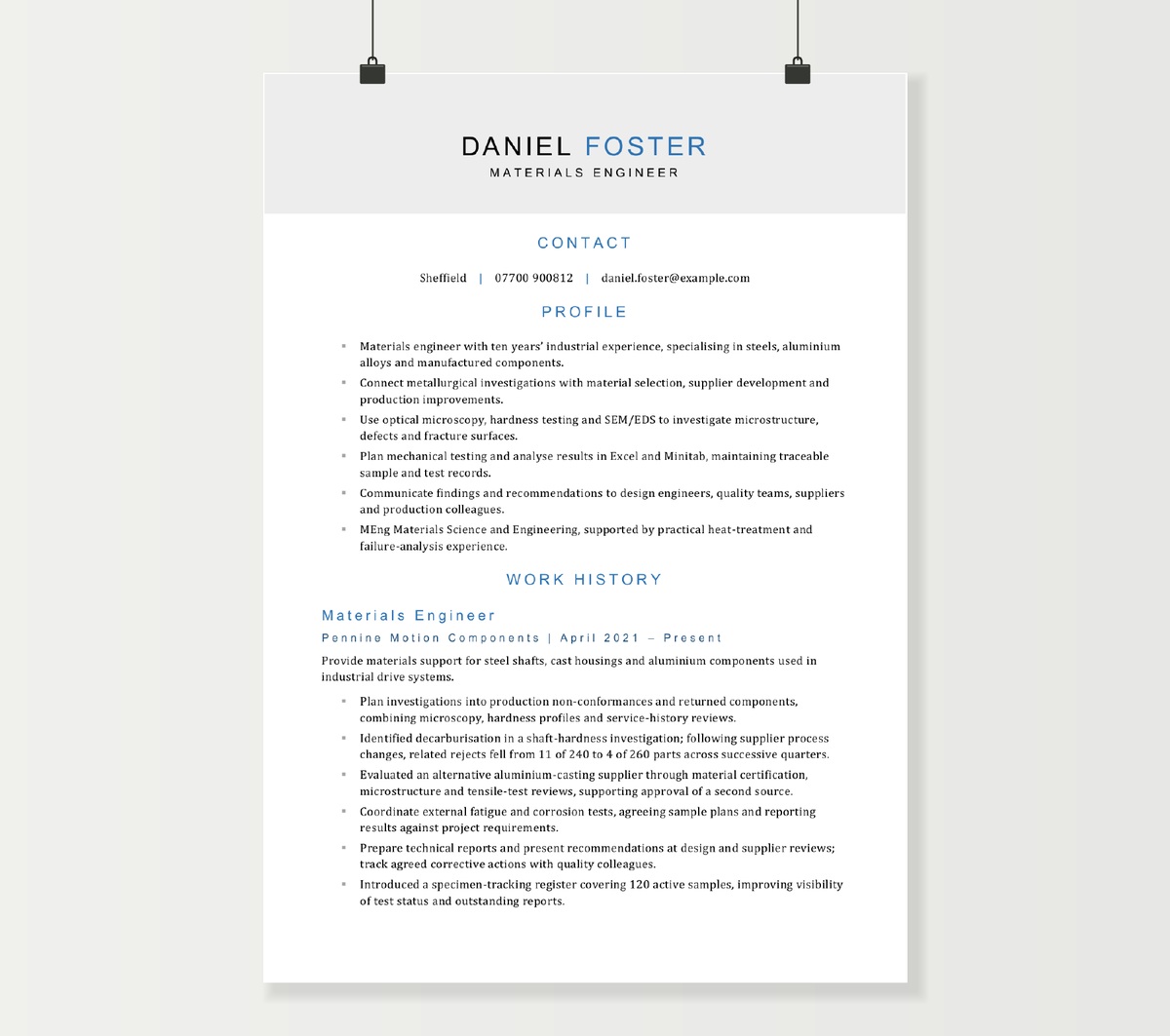
This materials engineer CV template follows a metals specialist supporting manufactured components, from laboratory investigation to supplier and production decisions. The Word example covers testing, failure analysis, material evaluation and practical process improvements. The guide explains how to present your own materials specialism, research or industrial projects and the engineering decisions your work supports.
Filename: FreeCVDownload_Materials_Engineer.docx
Content of this CV template
Daniel Foster
Materials Engineer
Contact
Sheffield | 07700 900812 | [email protected]
Profile
- Materials engineer with ten years’ industrial experience, specialising in steels, aluminium alloys and manufactured components.
- Connect metallurgical investigations with material selection, supplier development and production improvements.
- Use optical microscopy, hardness testing and SEM/EDS to investigate microstructure, defects and fracture surfaces.
- Plan mechanical testing and analyse results in Excel and Minitab, maintaining traceable sample and test records.
- Communicate findings and recommendations to design engineers, quality teams, suppliers and production colleagues.
- MEng Materials Science and Engineering, supported by practical heat-treatment and failure-analysis experience.
Work history
Materials Engineer
Pennine Motion Components | April 2021 – Present
Provide materials support for steel shafts, cast housings and aluminium components used in industrial drive systems.
- Plan investigations into production non-conformances and returned components, combining microscopy, hardness profiles and service-history reviews.
- Identified decarburisation in a shaft-hardness investigation; following supplier process changes, related rejects fell from 11 of 240 to 4 of 260 parts across successive quarters.
- Evaluated an alternative aluminium-casting supplier through material certification, microstructure and tensile-test reviews, supporting approval of a second source.
- Coordinate external fatigue and corrosion tests, agreeing sample plans and reporting results against project requirements.
- Prepare technical reports and present recommendations at design and supplier reviews; track agreed corrective actions with quality colleagues.
- Introduced a specimen-tracking register covering 120 active samples, improving visibility of test status and outstanding reports.
Graduate / Materials Engineer
Trent Materials Laboratory | September 2016 – March 2021
Progressed from supervised testing to managing small customer investigations for engineering and manufacturing businesses.
- Prepared metallographic sections, assessed microstructures and completed hardness and tensile testing to controlled methods.
- Used SEM/EDS to examine fracture surfaces and inclusions, discussing findings with the senior metallurgist before reporting.
- Compared heat-treatment trials for a steel component, linking hardness variation to processing records and recommending further validation.
- Coordinated sample intake and customer updates, balancing urgent failure investigations with scheduled testing.
Materials Engineering Placement Student
Trent Materials Laboratory | July 2014 – June 2015
Completed an industrial placement during an integrated master’s degree.
- Prepared samples and assisted with optical microscopy and mechanical tests.
- Analysed repeatability data for a hardness-testing study and presented findings to the laboratory team.
Qualifications and development
MEng Materials Science and Engineering — 2:1
University of Sheffield | 2016
Technical development
SEM/EDS interpretation workshop (2023); heat-treatment problem solving (2024); experimental design and Minitab training (2025).
Hobbies and interests
I enjoy cycling, playing guitar and walking in the Peak District.
How to write a materials engineer CV
A materials engineer CV should show how your understanding of a material helps someone make a better engineering decision. That may mean selecting an alloy, qualifying a composite process, investigating a failed component or deciding what further testing is needed. A list of laboratory techniques gives only part of the picture. The strongest examples connect the material, its processing or service conditions, the evidence you gathered and the recommendation that followed.
Lead with your materials specialism and application
Identify the material families and environments that make your experience relevant. Steels used in drive components, polymer composites for aircraft structures and coatings exposed to a corrosive environment each suggest a different set of capabilities. Put that context in the profile, followed by your principal contribution: manufacturing support, failure analysis, selection, qualification or development.
Your level of responsibility matters too. An engineer managing external test programmes has a different remit from a laboratory specialist conducting and interpreting tests or a technical lead approving recommendations. Describe your own scope near the top. If your career combines several of these, use the vacancy to decide which should receive most attention.
For an application outside your current sector, explain the connection through materials, processes and engineering problems. Heat-treatment experience, fracture interpretation or process control may transfer across industries even where the products differ. A reader can assess that transfer more readily when the underlying work is clear.
Give a project enough context to make the result meaningful
Under each employer, start with the components or materials you support and the purpose of the work. Then develop selected examples around an engineering question. Was a supplier’s process capable of meeting the specification? Why had a part failed? Could a different material or manufacturing route meet the design requirements?
A useful project bullet usually includes the material or component, your investigation or evaluation and the decision it supported. For instance, comparing an alternative casting supplier through certification, microstructure and mechanical-test evidence shows a different contribution from simply recording that you “supported procurement”. It explains why materials expertise was needed.
Use scale where it helps: the number of variants, test conditions, production batches or suppliers. Test counts alone may not convey complexity. A small, carefully designed comparison can be more significant than hundreds of routine measurements. Explain the scope in terms relevant to the work, then give the outcome or next decision.
The product design engineer CV example provides a useful comparison if your materials work closely supports product development. Keep your own CV centred on the materials evidence behind the design decision.
Make laboratory techniques demonstrate capability
Group technical skills by their use rather than presenting one long list. A reader should be able to distinguish specimen preparation, test operation, analysis and interpretation. These are related capabilities, but they represent different experience.
- Characterisation: identify the methods relevant to your specialism, such as optical microscopy, SEM/EDS, thermal analysis or spectroscopy, and the questions you use them to investigate.
- Mechanical or environmental testing: show the types of loading, property or exposure you assess and your responsibility for planning, running or reviewing the work.
- Processing: connect material behaviour to relevant manufacturing experience, such as casting, heat treatment, joining, moulding or composite processing.
- Analysis and records: name the software used for statistics, image analysis, modelling or data handling, with an example of its purpose.
Choose the methods that help establish suitability for the role. A metals-focused vacancy may value microstructural interpretation and fracture analysis; a polymer role may place more weight on thermal behaviour, formulation and processing-property relationships. Technical breadth is useful when the employment or project evidence explains it.
If testing is carried out externally, show your contribution to the sample plan, method selection, acceptance criteria, supplier coordination and interpretation. Managing a sound test programme is substantial engineering work in its own right. The CV can demonstrate this without suggesting you operated equipment used by another laboratory.
Present failure analysis as an investigation, not just a finding
A strong failure-analysis example explains how you brought evidence together. Material examination may be one part of the story alongside service history, loading, manufacturing records, inspection results and component geometry. Mention the sources that were decisive and the colleagues who contributed.
The useful outcome may be a supported failure mechanism, a corrective action, a design review or a recommendation for further testing. State which was achieved. If you investigated fracture surfaces and advised the design team, describe that engineering contribution. If you also verified the change through follow-up testing or production data, include that later evidence.
For senior roles, add how you scoped the investigation, prioritised urgent work, reviewed others’ conclusions or communicated uncertainty to decision-makers. A technical report can be an important deliverable when it explains a consequential decision. Name its audience and purpose rather than simply saying you have good report-writing skills.
Show how your work reached production or qualification
Materials and process development gains weight when the reader can see what happened after the laboratory work. Relevant evidence includes agreed process limits, revised specifications, supplier trials, validation programmes, non-conformance reviews and the transfer of a method into routine production.
Distinguish evaluation from formal qualification. A screening study compares possibilities; a qualification programme supplies evidence against defined requirements. Explain the stage you delivered and the approval or review it supported. If your role included formal technical authority, identify its scope within the employer or programme.
Production-support applicants should show how they worked with quality, manufacturing and suppliers. For example, an investigation that led to a revised supplier process and lower related rejection levels connects materials knowledge with a practical result. Where you helped implement a corrective action, explain the follow-up used to establish whether it worked.
Standards and quality systems belong on the CV when they affected your work. State the testing or reporting context and your involvement. Experience in an accredited laboratory can be relevant, as can working to customer material specifications or controlled methods. A short explanation of the application is more useful than a dense list of standard numbers.
Choose results that reflect the evidence available
Useful materials-engineering outcomes include fewer related rejects, a second source approved for supply, an agreed process change, a completed test package or a design decision supported by better data. Explain the connection between your work and the result. If several teams delivered the improvement, identify your part alongside the shared outcome.
For quality figures, give the denominator and comparison period when needed. Eleven rejected parts out of 240 and four out of 260 convey more than two percentages with no production context. Where a change affects weight, cost, durability or performance, specify the component or test basis so the reader understands what was measured.
Not every project will have reached a production outcome. A test programme can still be valuable because it closed a knowledge gap, eliminated an unsuitable option or gave the project team a clear next step. Describe the decision enabled and the stage reached. That is particularly useful for development programmes with long qualification cycles.
Translate a degree, PhD or research project into engineering evidence
For an early-career application, give a substantial project its own short entry. State the question, material system, experimental or analytical approach, your contribution and the main finding. Include the practical work you performed and how you assessed the data. A concise account of repeatability, comparison conditions or unexpected results can demonstrate judgement better than a list of modules.
A PhD applicant moving into industry should foreground the parts that match the vacancy: designing experiments, characterisation, working with external partners, managing equipment or test resources, interpreting results and presenting recommendations. Explain the application before specialist detail so an engineering manager can see why the research matters.
Publications, conference presentations and patents deserve selective treatment. A small number of relevant outputs can support research or development applications; a separate publication list can carry the rest. Manufacturing-support roles usually benefit from more space for problem solving, reproducible methods and collaboration. The mechanical engineer CV example offers another perspective on presenting technical projects around their engineering purpose.
Use development and progression to show direction
List your degree and discipline, followed by relevant technical training and professional membership or registration. Where you are working towards a qualification or registration, state that stage clearly. Recent training is most useful when it explains an expanding capability that appears elsewhere in the CV.
Progression can also be shown through responsibility: moving from sample preparation to interpretation, from small investigations to customer projects, or from individual tests to a coordinated development programme. For a senior application, include technical review, mentoring, external laboratory management and the decisions for which colleagues rely on you. This gives the reader a picture of both your expertise and how you contribute to the wider engineering team.
Materials Engineer CV FAQs
Where the vacancy accepts a related discipline, make the relevant materials content easy to find. Highlight projects, laboratory work, manufacturing experience or research involving material behaviour and selection. The degree title is useful context, but a developed example showing how you investigated a material and interpreted the evidence often makes the connection much clearer.
Place it with the project or training in which you used it, and describe the activity: specimen preparation, supervised operation, analysis of supplied data or interpretation of results. This gives the reader a practical understanding of your starting point. More established methods can sit in the main skills section with recent employment evidence.
Usually a short selection is enough unless the role is strongly research-focused. Choose outputs that demonstrate relevant materials knowledge, a method or an application, and identify your contribution where helpful. For production, supplier-support or failure-analysis positions, project decisions and implemented recommendations generally deserve more space than a complete bibliography.
Describe the material family, component type, general service environment and investigation methods at a level you can share. Focus on your reasoning, collaboration and the decision supported. A project can demonstrate strong failure-analysis experience without naming the customer, product programme or commercially sensitive failure rate.
Identify the transferable foundation, such as experimental design, mechanical testing, process control, traceability and technical reporting, then add any direct work or training with the target material family. Explain the materials and processing routes you know rather than presenting all characterisation experience as interchangeable. A project or course involving the new material can make that transition more tangible.
Present ISO/IEC 17025 as the laboratory or testing context, with your own responsibilities alongside it. For example, you might describe experience with controlled methods, traceable records, equipment checks or quality reviews in an accredited laboratory. If you completed a specific training course, list that course separately with its provider and date.




