
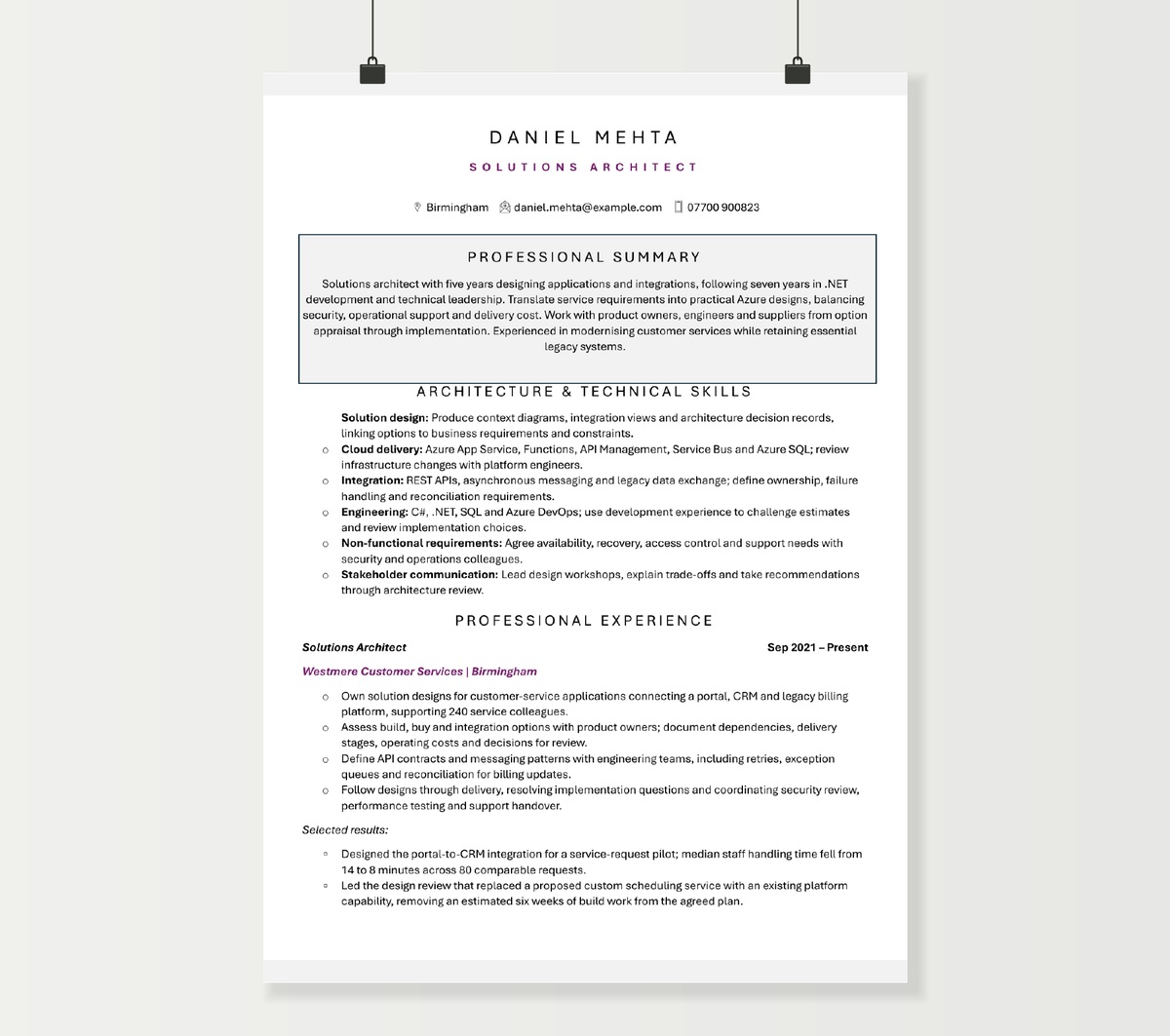
This solutions architect CV template follows an experienced .NET developer who moved into application and integration architecture. The Word example connects Azure knowledge with design decisions, delivery governance and business results. The guide explains how to present architecture work, select useful project evidence and show the depth behind your technical skills.
Filename: FreeCVDownload_Solutions_Architect.docx
Content of this CV template
Daniel Mehta
SOLUTIONS ARCHITECT
Birmingham | [email protected] | 07700 900823
Professional summary
Solutions architect with five years designing applications and integrations, following seven years in .NET development and technical leadership. Translate service requirements into practical Azure designs, balancing security, operational support and delivery cost. Work with product owners, engineers and suppliers from option appraisal through implementation. Experienced in modernising customer services while retaining essential legacy systems.
Architecture & technical skills
- Solution design: Produce context diagrams, integration views and architecture decision records, linking options to business requirements and constraints.
- Cloud delivery: Azure App Service, Functions, API Management, Service Bus and Azure SQL; review infrastructure changes with platform engineers.
- Integration: REST APIs, asynchronous messaging and legacy data exchange; define ownership, failure handling and reconciliation requirements.
- Engineering: C#, .NET, SQL and Azure DevOps; use development experience to challenge estimates and review implementation choices.
- Non-functional requirements: Agree availability, recovery, access control and support needs with security and operations colleagues.
- Stakeholder communication: Lead design workshops, explain trade-offs and take recommendations through architecture review.
Professional experience
Solutions Architect | Sep 2021 – Present
Westmere Customer Services | Birmingham
- Own solution designs for customer-service applications connecting a portal, CRM and legacy billing platform, supporting 240 service colleagues.
- Assess build, buy and integration options with product owners; document dependencies, delivery stages, operating costs and decisions for review.
- Define API contracts and messaging patterns with engineering teams, including retries, exception queues and reconciliation for billing updates.
- Follow designs through delivery, resolving implementation questions and coordinating security review, performance testing and support handover.
Selected results:
- Designed the portal-to-CRM integration for a service-request pilot; median staff handling time fell from 14 to 8 minutes across 80 comparable requests.
- Led the design review that replaced a proposed custom scheduling service with an existing platform capability, removing an estimated six weeks of build work from the agreed plan.
Developer / Technical Lead | Aug 2014 – Aug 2021
Harborne Software Services | Birmingham
- Developed business applications in C# and SQL; promoted to Technical Lead in 2018, guiding a five-person development team.
- Translated customer requirements into application designs, delivery estimates and work packages for service-management projects.
- Reviewed code and database changes, investigated production faults and supported releases with testing and operations colleagues.
- Worked with client analysts on data migration, interface mapping and acceptance criteria for replacement applications.
Selected contributions:
- Led the move from manual deployment to an Azure DevOps pipeline for three applications, reducing typical release preparation from half a day to around one hour.
- Introduced design walkthroughs before development, helping the team resolve interface dependencies earlier in the delivery cycle.
Education & development
BSc (Hons) Computer Science — 2:1 – Aston University, 2014
Microsoft Certified: Azure Administrator Associate – 2023; renewed 2026
Microsoft Certified: Azure Solutions Architect Expert – 2025; renewed 2026
Architecture modelling and design review workshops – employer training, 2024
Additional information
- Architecture practice: Facilitate monthly design discussions and maintain reusable integration patterns with the wider engineering team.
- Delivery experience: Agile product teams, supplier-led implementations and phased transitions from on-premises applications to Azure.
- Interests: Hillwalking, cooking and building small home-automation projects.
How to write a solutions architect CV
A solutions architect CV needs to make your judgement visible. Employers need to understand the kinds of problems you can design for, the decisions you have owned and how closely you have worked with the people who implement and operate the result. A page of cloud services and architecture frameworks leaves those questions unanswered.
The strongest evidence connects a business requirement to a design choice and then to delivery. That connection can come from a major transformation programme, a difficult integration or a smaller service whose operating constraints demanded careful decisions.
Establish what kind of solutions architect you are
The title covers application, cloud, integration and business-system roles with quite different expectations. Use your profile to establish your main territory: the systems you design, the environments you know and the level of responsibility you hold. “Application and integration architect with a .NET background, designing Azure services around legacy customer systems” is more informative than “innovative technology leader”.
Add relevant business context when it changes the work. Insurance policy administration, public-sector corporate services and subscription products introduce different data, operational and integration requirements. Explain enough for the reader to recognise that context; a string of internal programme names will not do it.
For a senior role, bring out the reach of your decisions: several delivery teams, a cross-system migration, a supplier selection or standards adopted across a product area. For a first architect appointment, lead with the design ownership already present in your technical-lead, engineering or consulting work.
Choose projects that demonstrate different decisions
Two or three well-chosen projects can explain your experience more effectively than a catalogue of every platform you have touched. Choose projects with distinct demands. One might demonstrate integration with a legacy system; another might show a build-or-buy decision, a phased migration or the design of a service with demanding recovery requirements.
Place these examples under the employer where the work happened, so the dates and your role remain clear. A short project heading is useful when you have several assignments within one job. For each, cover the following evidence in a compact paragraph or a few bullets:
- The business service and the problem or change it needed.
- Your decision-making responsibility and the teams or suppliers involved.
- A significant constraint, such as existing interfaces, delivery timing, operating cost or availability.
- The design choice you made or recommended, including the relevant alternative.
- How the work progressed and what result was observed.
This gives your technology choices a purpose. “Designed event-driven integration” becomes much stronger when the reader can see which systems needed to exchange information, why loose coupling mattered and how failed updates were recovered.
Give trade-offs a place in your experience
Architects are often assessed on their ability to choose between workable options. Your CV can show this without reproducing an entire design paper. Select a decision where the constraint was meaningful: reusing a platform rather than building a new service, retaining a batch interface during migration, or choosing managed infrastructure to fit the available support team.
A useful bullet might read: “Recommended a staged API layer around the existing billing system, allowing the portal launch to proceed while the replacement finance platform remained in procurement.” The reader can see the dependency, the recommendation and its delivery value.
Architecture decision records, options appraisals and high-level designs belong in the CV when you explain what they enabled. “Produced HLDs” describes an output. “Secured agreement on the integration approach by comparing support cost, failure handling and delivery dependencies” shows the judgement behind it.
Show cloud depth through the architecture
Organise cloud knowledge around the work you have done. An Azure architect might group application hosting, integration, identity, data and deployment tooling. An AWS architect might present equivalent areas using the services relevant to their projects. This makes the skills section readable while allowing the experience section to explain how those services worked together.
Show the boundary of your involvement. Designing the target architecture, building a proof of concept, reviewing infrastructure code and owning platform operations are different contributions. Clear verbs help a technical reviewer understand where to explore your experience.
Migration work is particularly useful when you include the difficult parts: application dependencies, data movement, transition states, rollout sequence, rollback arrangements and support readiness. A cloud destination alone tells the reader little about the complexity you handled.
If one platform is your main area, give it the most detail. Other environments can appear in a shorter supporting line, with context such as supplier integration, assessment or earlier delivery experience. This creates a more useful picture than presenting every cloud provider at the same level.
Explain integration and data responsibilities
Integration is often where a solution becomes operationally difficult. Describe the systems and boundaries you worked across: CRM to billing, SaaS to an internal data platform, customer-facing APIs to legacy applications, or information exchanged between organisations.
Relevant evidence includes API contracts, event or message patterns, data ownership, identity boundaries, interface versioning and reconciliation. Choose the items that mattered in your project, then explain your contribution. A bullet about agreeing error handling and replay requirements with engineering and operations can demonstrate more maturity than a long list of messaging products.
For data-intensive work, distinguish your architectural decisions from implementation undertaken by data engineers. You might have agreed the system of record, access pattern, retention needs or migration approach while another team built the pipelines. That division helps readers understand the scale and collaboration involved.
Make non-functional requirements concrete
Security, resilience, performance and cost are easy to list and harder to demonstrate. Use evidence of a requirement you helped define, a design response and the way it was evaluated. Examples include translating service recovery needs into a tested recovery design, agreeing performance criteria for a peak period or comparing operating costs before approving a hosting option.
State whether a number is a target, a test result or an observed production measure. “Designed for a four-hour recovery target” and “demonstrated recovery within four hours during the acceptance exercise” communicate different stages of evidence. Both can be valuable when presented clearly.
Security work becomes more informative when the CV identifies the collaboration and decision: agreeing identity and access boundaries with security colleagues, resolving a threat-review finding or incorporating audit requirements into a supplier design. This also shows how specialist input shaped the solution.
Follow the design through delivery
Explain what happened after approval. Employers may want an architect who remains involved in implementation, resolves emerging constraints and helps a service reach stable operation. Useful evidence includes design walkthroughs, engineering reviews, supplier assurance, test acceptance, migration decisions and handover to support.
Describe a design change where practical delivery information altered the approach. This shows that you can maintain architectural direction while responding to evidence. Technical debt can also be good CV material when you explain the decision, its owner and the planned route to resolution.
Governance experience should show its purpose. Taking a proposal through a design authority, gaining agreement on an exception or aligning several teams around a common interface demonstrates influence. Simply naming the committees you attended adds much less.
Connect architecture to business value
Architecture results are not limited to system speed or availability. A design may enable a product launch, reduce manual processing, shorten a supplier implementation, simplify support or remove duplicated capability. Use the outcome closest to the decision you made.
Give the basis of a metric briefly. Handling time across a defined pilot, cloud cost over a stated period or release preparation before and after a change is understandable evidence. Where several teams delivered the result, identify your architectural contribution and then the shared outcome.
Estimates also have a place. An options appraisal might remove six weeks of planned development or reduce forecast operating cost. Describe this as an estimate or a change to the approved plan, keeping it distinct from realised savings. Where measurement is unavailable, a concrete outcome such as an agreed transition design, successful cutover or approved supplier approach still shows progress.
Show how you communicate with different audiences
Replace broad claims about communication with the situations that required it. You may have translated a service problem with a product owner, negotiated an interface with a supplier, explained a cost trade-off to finance or helped a delivery team understand the consequences of an architectural decision.
For stakeholder workshops, say what was resolved. Agreement on scope, ownership, non-functional requirements or a delivery dependency is useful evidence. If you worked closely with analysts, show how business requirements became design decisions; the business analyst CV example offers a complementary view of requirements and stakeholder work.
Present progression, qualifications and supporting evidence
A development or engineering background can be a major strength. Keep enough detail to show that you understand implementation, then give more space to the responsibilities that moved you towards architecture: cross-system design, technical options, non-functional requirements, supplier assessment and decisions spanning more than one team. The software developer CV is useful if your current role still combines substantial coding with design leadership.
Put relevant cloud credentials and architecture training in a clear qualifications section, using the exact award name and completion or current renewal date where applicable. Follow them with applied evidence in employment. A certification can establish structured knowledge; a project explains how you used it under real constraints.
An optional portfolio can contain a short design case study, a context diagram and an explanation of alternatives and decisions. It should be easy to read without knowing your employer’s internal terminology. For many experienced applicants, strong project accounts within the CV are sufficient. Choose supporting material that adds something the employment section cannot show on its own.
Solutions Architect CV FAQs
Both forms appear in UK vacancies. Use the advertised form in your profile or application heading, while keeping your actual employment titles in the career history. The scope of your work matters more than the extra ‘s’; a short description of your application, cloud or integration focus gives the title useful meaning.
Yes, where your work includes the decisions the role requires. Bring out cross-system design, option appraisal, non-functional requirements and agreement with teams beyond your own. Keep the technical-lead title and make that architectural responsibility clear beneath it. A promotion within one employer can also show how your remit expanded over time.
Use the vacancy's balance of design and engineering work as your guide. Application architecture roles may explicitly require current C# or Java experience, code review and proof-of-concept development. Other roles concentrate on SaaS selection, integration and governance. Give recent coding evidence when it supports the appointment, and retain a concise engineering background where it explains your implementation judgement.
Give each assignment its dates, client context, purpose and result. If you worked through one consultancy, group the assignments beneath that employer and use project subheadings. For independent contracts, separate entries can work well. Make the lifecycle stage clear: discovery, design, implementation assurance or transition to service, so a short engagement has an understandable endpoint.
Describe the completed stage and the decision it supported. An approved target design, a supplier comparison, a costed transition plan or a recommendation to stop an unsuitable option can demonstrate valuable architecture work. State the programme's endpoint briefly and give other delivered projects more space where they provide evidence of implementation experience.
It depends on the evidence you want to add. A short case study showing context, alternatives and a reasoned decision is often more useful for architecture review than a code repository alone. GitHub can add value for an engineering-heavy role through a focused prototype or reference implementation, especially when a clear README explains its design choices and limitations.




