This tiler CV template shows progression from an apprenticeship into domestic refurbishment and commercial fit-out work. The Word example covers preparation, setting out, installation and handover. The guide explains how to present your workmanship, materials experience, qualifications and reliability for tiling jobs.
Filename: FreeCVDownload_Tiler.docx
Content of this CV template
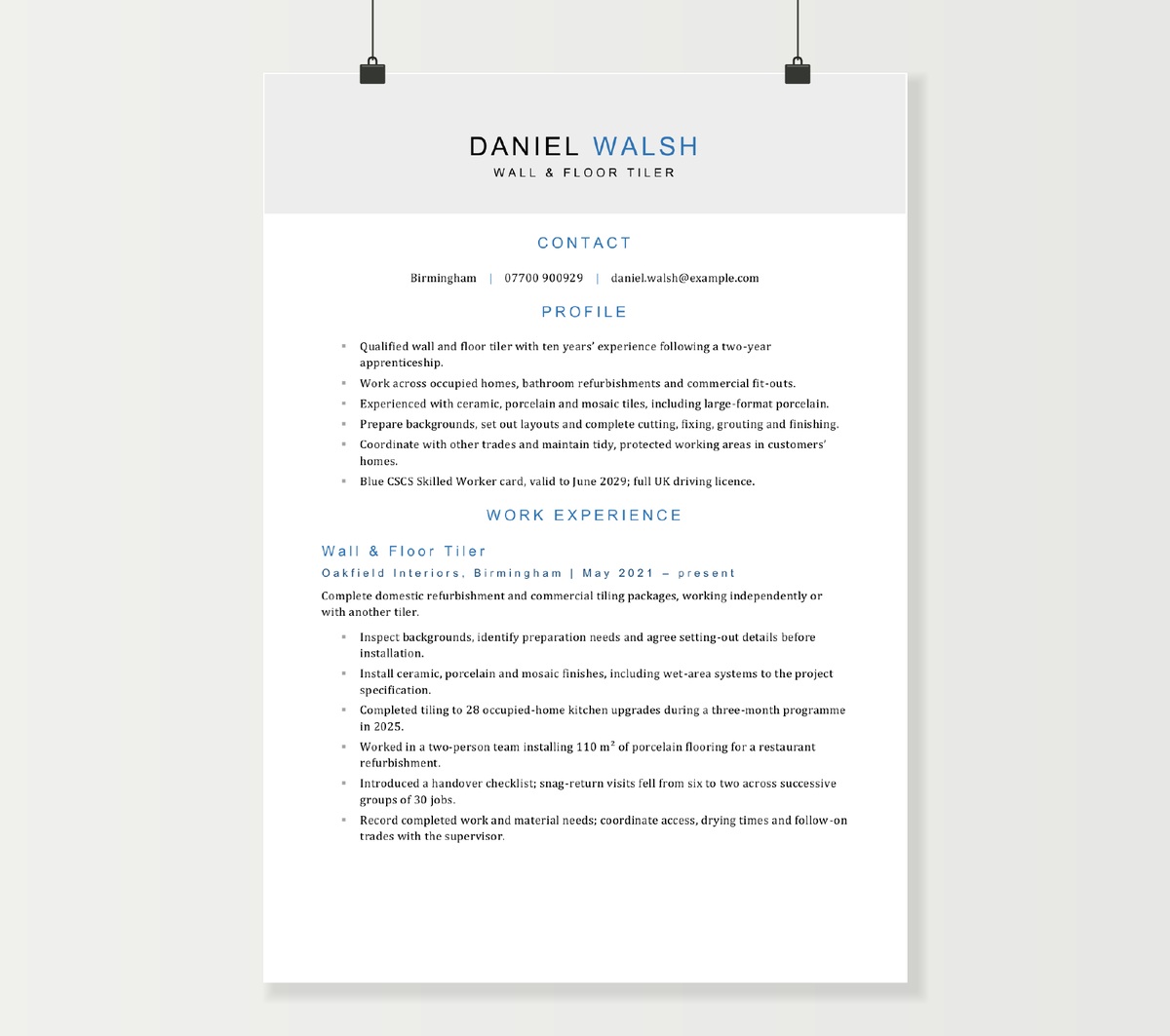
Daniel Walsh
Wall & Floor Tiler
Contact
Birmingham | 07700 900929 | [email protected]
Profile
- Qualified wall and floor tiler with ten years’ experience following a two-year apprenticeship.
- Work across occupied homes, bathroom refurbishments and commercial fit-outs.
- Experienced with ceramic, porcelain and mosaic tiles, including large-format porcelain.
- Prepare backgrounds, set out layouts and complete cutting, fixing, grouting and finishing.
- Coordinate with other trades and maintain tidy, protected working areas in customers’ homes.
- Blue CSCS Skilled Worker card, valid to June 2029; full UK driving licence.
Work experience
Wall & Floor Tiler
Oakfield Interiors, Birmingham | May 2021 – present
Complete domestic refurbishment and commercial tiling packages, working independently or with another tiler.
- Inspect backgrounds, identify preparation needs and agree setting-out details before installation.
- Install ceramic, porcelain and mosaic finishes, including wet-area systems to the project specification.
- Completed tiling to 28 occupied-home kitchen upgrades during a three-month programme in 2025.
- Worked in a two-person team installing 110 m² of porcelain flooring for a restaurant refurbishment.
- Introduced a handover checklist; snag-return visits fell from six to two across successive groups of 30 jobs.
- Record completed work and material needs; coordinate access, drying times and follow-on trades with the supervisor.
Tiler
Midlands Ceramic Services | Sep 2016 – Apr 2021
Delivered wall and floor tiling on housing developments, shop refits and bathroom projects.
- Read drawings, measure areas and set out tile layouts around openings, fittings and changes of level.
- Prepared substrates and fitted tiles, trims and specified movement joints.
- Used manual cutters and wet saws, following site arrangements for dust, noise and waste.
- Completed finishing checks and helped apprentices with cutting, preparation and organised working.
Apprentice Tiler
Midlands Ceramic Services | Sep 2014 – Aug 2016
Combined supervised site work with training towards a wall and floor tiling qualification.
- Assisted with surface preparation, measuring, tile cutting, fixing and grouting.
- Learned to protect finished surfaces and keep tools, materials and work areas ready for the team.
Qualifications & training
Level 2 NVQ Certificate in Wall and Floor Tiling (Construction)
City & Guilds | 2016; apprenticeship completed August 2016
Site and product training
Asbestos awareness refresher, 2026; wet-area waterproofing systems, 2025
Interests
Fishing, five-a-side football and restoring old bicycles.
How to write a tiler CV
A tiler CV should help an employer picture the work you can take on: the surfaces and materials you know, the preparation you handle and the standard of finish you deliver. Give that practical evidence early, alongside the qualifications and site information needed for the job.
Domestic refurbishment, commercial fit-out and planned housing work place different demands on a tiler. Select examples that match the work you want, while showing enough range to explain your experience.
Describe your tiling background precisely
Start with wall and floor tiling experience, your main working environments and any useful specialism. Ceramic bathrooms, large-format porcelain floors, natural stone, mosaics and detailed decorative layouts each tell an employer something different.
State whether you normally complete jobs independently, work within a tiling team or support a wider refurbishment crew. For a lead role, include planning work for others, inspecting finishes or coordinating a package with the site manager.
Daniel’s example identifies ten years after his apprenticeship and a mix of occupied homes and commercial projects. The employment history then gives enough detail to support that opening, rather than repeating a list of personal qualities.
Show the work behind the finished surface
Good tiling evidence includes preparation as well as fixing. Describe the backgrounds you have worked on, the preparation you completed and the checks or issues you raised before starting. An employer needs to understand whether your experience covers the full package or a particular stage.
Useful CV details might include substrate preparation, levelling, setting out, accurate cutting, trims, grouting, sealant work and specified movement joints. Connect these to a project or type of work instead of filling a section with isolated trade terms.
For wet rooms and other wet areas, identify your experience with the specified waterproofing system and the scope you handled. A product-training entry can support practical experience. The CV needs to establish your familiarity and responsibility, rather than explain installation procedures.
If you spotted an unsuitable background, a drawing discrepancy or a material issue, explain how you raised it and what was agreed. This shows the judgement that helps a job progress smoothly.
Make materials and setting-out experience meaningful
List the tile types relevant to the vacancy, then use selected jobs to show the work involved. For example, a porcelain floor entry can include the area, format and setting-out challenge; a bathroom entry might describe mosaics, niches or alignment around fittings.
“Large-format experience” becomes clearer when you give a typical size or a particular installation. Natural-stone work can be described by the material and finish you handled. Include specialist experience where it helps the employer assess the proposed work.
Drawings and specifications are worth mentioning if you use them to plan layouts, identify details or coordinate work. Describe the practical use, such as setting out a repeated bathroom layout or resolving an interface with a door threshold.
Tools should support the account. Familiarity with manual cutters, wet saws, laser levels or specialist handling equipment matters when it relates to the materials and scale of your work. A short, relevant list is easier to assess than an inventory of every hand tool.
Choose project examples that demonstrate workmanship
Use employment bullets or a short selected-work section to give a few representative examples. Include the setting, your tiling scope and a useful result or handover detail.
- A domestic project can show preparation, a detailed finish and communication with the customer.
- A commercial package can show drawings, larger areas, teamwork and coordination with the programme.
- A housing-maintenance example can show repeat appointments, repairs, occupied-property working and completion records.
- A specialist installation can show a material, layout or system that is central to the vacancy.
Describe your share of a team’s work. Daniel’s restaurant example gives the floor area and states that two tilers completed it. This makes the scale useful without leaving the reader to assume he carried out the whole installation alone.
Completion quality can be demonstrated through accepted handovers, fewer snag visits, repeat work or a supervisor’s inspection record. Where a figure is available, give the period or number of jobs it relates to. Daniel’s checklist result compares two groups of 30 jobs, making the change understandable.
Put productivity in the context of the job
Area completed, bathrooms handed over or appointments finished can show workload. Include the type of tiling and the scope behind the number. Preparation, tile format, access, patterns and the work of other trades all affect what a daily or weekly output means.
A useful achievement combines delivery with quality. You might describe completing your package within a phased handover, organising materials to keep a repeated programme moving or reducing return visits by improving finishing checks.
If your strongest evidence is a difficult detail or a well-managed customer job, use that. A tiler CV can be persuasive through specific workmanship and responsibility without needing a percentage in every role.
Include the practical demands of occupied homes and site work
For domestic and social-housing jobs, show how you organise access, protect belongings, explain disruption and leave the work area. These details tell an employer how you represent the company while working in someone’s home.
For site work, give evidence of coordination with the supervisor and other trades. This might include planning around prepared backgrounds, checking material availability, allowing for agreed drying times or recording completed areas for the next stage.
Safety experience is best presented through the work you do and relevant training. Mention the site arrangements you follow for cutting dust, manual handling, equipment and waste where they are part of your regular responsibilities. A clear training list can support the employment evidence.
For maintenance roles, distinguish tiling from any additional trades. Describe the repairs or making-good work you undertake, and the tasks you coordinate with other specialists. This helps the recruiter understand the fit for a tiler vacancy or a broader maintenance post.
Make qualifications, cards and availability easy to find
Give the full title and level of your trade qualification, awarding body and completion date. List an apprenticeship separately where useful. An NVQ or SVQ, a college diploma and manufacturer training communicate different kinds of preparation, so clear titles help the employer assess them.
For a site card, include the card type and expiry date. Place this near the opening profile or qualifications if it is a stated requirement. Add relevant recent training, such as asbestos awareness or a system-specific course, with the date and provider where available.
Driving licence, access to transport, travel area and availability can be useful for mobile or contract work. Include what affects your suitability for the assignment. If the advert asks for your own tools, a concise statement of the relevant equipment is enough for the CV; detailed arrangements can be discussed with the recruiter.
Use photographs as supporting evidence
A small selection of clear project photographs can strengthen a tiler’s application, especially for detailed domestic work or specialist finishes. Keep the CV readable and provide a separate short portfolio or a link when useful.
Caption each project with the tile type, approximate scope and the work you completed. Include a wider view and a useful detail so the reader can understand both the layout and the finish. Preparation photographs can add evidence that is invisible in the finished surface.
Choose work you can share and keep customer addresses and identifying details out of the presentation. The written CV should still explain your experience, since photographs alone cannot show who completed each stage or how the job was managed.
Present apprenticeships, agency work and self-employment clearly
An apprentice or newly qualified tiler can use supervised jobs to show developing capability. State the work you carried out, the materials you used and the qualification completed or in progress. Practical placement evidence will usually be more relevant than a long list of school subjects.
For agency assignments, show the agency and dates, then group similar projects where that improves readability. Give selected sites enough detail to show the range of work and the responsibilities you held.
Self-employed tilers can use their trading name and dates as an employment entry. Alongside installations, include relevant estimating, material ordering, scheduling, customer communication and snag resolution. This makes the work visible as a sustained trade business, even when it consists of many small jobs.
Other editable layouts are available in the CV template library.
Tiler CV FAQs
No. A wall and floor tiling CV focuses on backgrounds, layouts, materials, fixing and finishing in settings such as bathrooms, kitchens and commercial interiors. Roof tiling involves a different trade and working environment. Use the full job title near the top so the recruiter can identify your specialism immediately.
Usually it is more useful to discuss the rate alongside the assignment, location, working arrangement and scope. Include it in an application message if the recruiter requests it. This keeps the CV reusable while allowing the commercial details to reflect the actual job.
List the exact qualification, provider and status, together with the expected completion date if known. Your employment section can show the tiling work already being assessed and the responsibilities you hold. Put an achieved award and an in-progress qualification on separate, clearly labelled lines.
Requirements depend on the site and employer. Many construction assignments specify a relevant card, while some domestic work does not. State your current card type and expiry if you hold one, and check the vacancy’s requirements. Trade qualifications and practical experience should remain visible alongside the card information.
Include additional trade experience where it is relevant to the role, with the scope and supporting qualifications clear. For a tiling application, coordination with plumbers and electricians can be useful evidence in its own right. A broader maintenance vacancy may need more detail about the other work you undertake.
A short, relevant reference to repeat business or documented feedback can support the CV. For a portfolio, an attributed review can be useful where it can be shared. Keep the main employment evidence focused on the installation, finish and service you delivered, with testimonials providing supporting context.
State that it was a joint or team installation, then identify your responsibilities and the overall project scale. You might have handled preparation and wall tiling while a colleague completed the floors, or shared the full package. This makes the example useful to an employer assessing how you would fit into a crew.