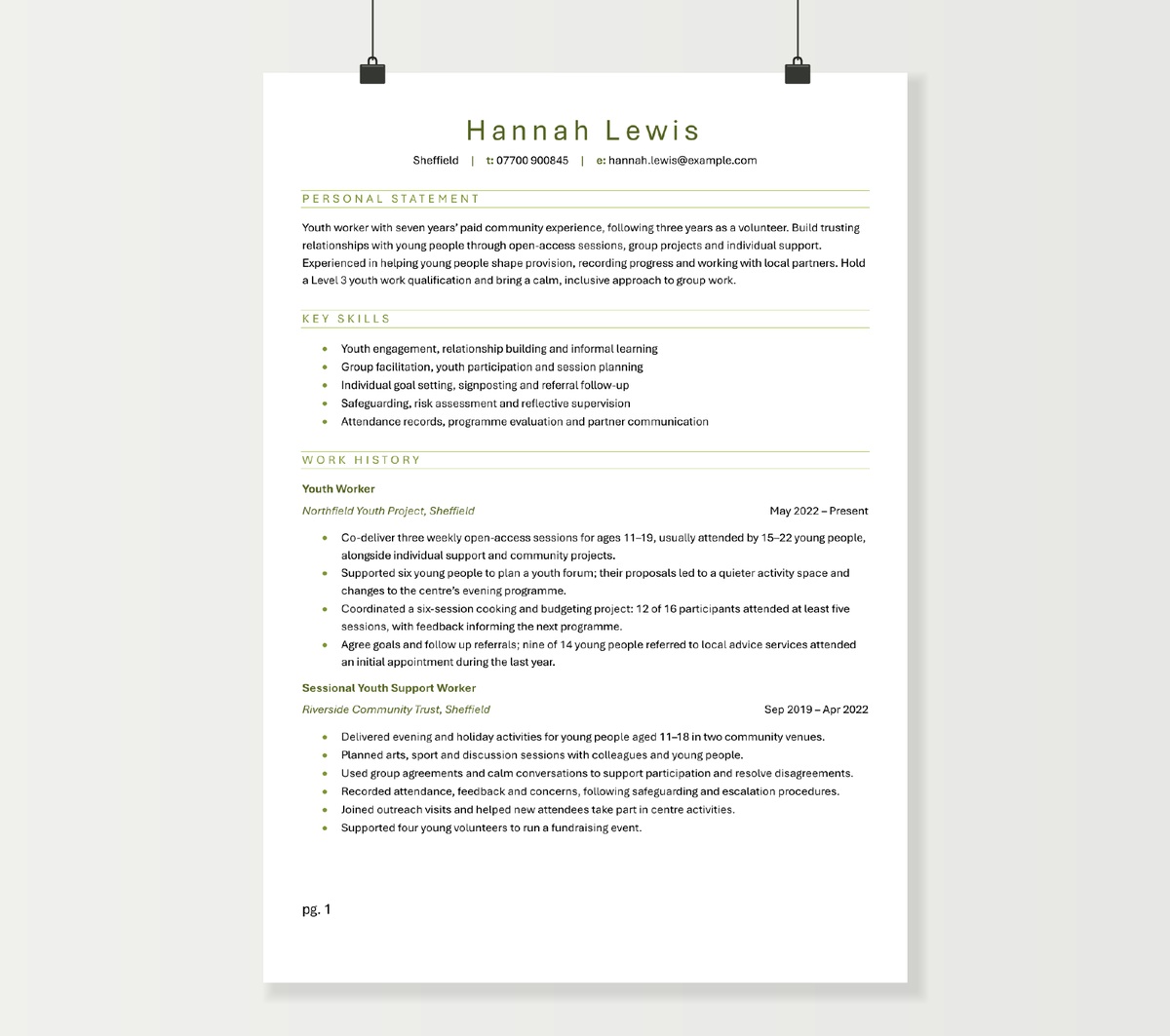
This youth worker CV template shows progression from volunteering into sessional and full-time community youth work. The Word example combines open-access sessions, individual support, young people’s participation and programme evaluation. The guide helps you present the relationships, judgement and practical contribution behind your youth work experience.
Filename: FreeCVDownload_Youth_Worker.docx
Content of this CV template
Hannah Lewis
Sheffield | t: 07700 900845 | e: [email protected]
Personal statement
Youth worker with seven years’ paid community experience, following three years as a volunteer. Build trusting relationships with young people through open-access sessions, group projects and individual support. Experienced in helping young people shape provision, recording progress and working with local partners. Hold a Level 3 youth work qualification and bring a calm, inclusive approach to group work.
Key skills
- Youth engagement, relationship building and informal learning
- Group facilitation, youth participation and session planning
- Individual goal setting, signposting and referral follow-up
- Safeguarding, risk assessment and reflective supervision
- Attendance records, programme evaluation and partner communication
Work history
Youth Worker
Northfield Youth Project, Sheffield
May 2022 – Present
- Co-deliver three weekly open-access sessions for ages 11–19, usually attended by 15–22 young people, alongside individual support and community projects.
- Supported six young people to plan a youth forum; their proposals led to a quieter activity space and changes to the centre’s evening programme.
- Coordinated a six-session cooking and budgeting project: 12 of 16 participants attended at least five sessions, with feedback informing the next programme.
- Agree goals and follow up referrals; nine of 14 young people referred to local advice services attended an initial appointment during the last year.
Sessional Youth Support Worker
Riverside Community Trust, Sheffield
Sep 2019 – Apr 2022
- Delivered evening and holiday activities for young people aged 11–18 in two community venues.
- Planned arts, sport and discussion sessions with colleagues and young people.
- Used group agreements and calm conversations to support participation and resolve disagreements.
- Recorded attendance, feedback and concerns, following safeguarding and escalation procedures.
- Joined outreach visits and helped new attendees take part in centre activities.
- Supported four young volunteers to run a fundraising event.
Volunteer Youth Club Assistant
Riverside Community Trust, Sheffield
Sep 2016 – Aug 2019
- Supported a weekly youth club alongside part-time retail work and later youth work training.
- Helped prepare games and creative activities, welcoming new members.
- Listened to young people’s ideas and shared feedback with the session leader.
- Assisted with attendance records, refreshments and safe close-down routines.
Qualifications
Level 3 Certificate in Youth Work Practice (England)
NOCN
2020
- NOCN qualification completed through workplace-supported study and assessed practice.
- Three A levels including Sociology and English Language, 2016.
- Emergency First Aid at Work, renewed 2025.
Recent development
Local youth sector training
2025 – 2026
- Safeguarding adolescents and contextual safeguarding (2026); group facilitation and trauma-informed practice (2025).
Hobbies and interests
- Music: Playing drums and attending local gigs.
- Outdoors: Walking in the Peak District.
- Cooking: Trying recipes from different cuisines.
Additional information
Full UK driving licence; experienced in evening and weekend provision and regular reflective supervision.
How to write a youth worker CV
A youth worker CV needs to show what sits behind the activities you deliver: relationships, informal learning, young people’s choices and careful professional judgement. A list of sports, trips and workshops tells an employer what happened, but not how you engaged people, adapted the work or supported their development.
Start by identifying the setting in the vacancy. Open-access youth clubs, detached work, targeted groups, school-based support and specialist projects can all appear under the title “youth worker”. Your CV should make the relevant setting and age group clear, then give examples of how you worked within it.
Establish your role and the young people you worked with
Introduce each job with the service, age range, type of provision and your responsibility. State whether you delivered sessions with colleagues, led a programme, worked with individual young people or supported a wider team. Session frequency and typical group size can establish scale without taking up much space.
A useful opening might be: “Co-delivered three weekly open-access sessions for ages 11–19, alongside individual support and community projects.” A targeted role might instead describe a referral-based programme, its purpose and how you worked with schools or other partners.
Explain specialist experience in terms the reader can use. Work with care-experienced young people, young carers, disabled young people or those seeking education and employment support should show your contribution and the setting. The strongest wording presents young people as participants with interests and goals, rather than defining them solely by a difficulty.
Show how you built and sustained engagement
Relationship building is central to youth work, so give it practical evidence. Describe how you welcomed new participants, kept contact, responded to feedback or helped someone move from observing to taking part. A repeat visit, a young person choosing to join a project or a group becoming involved in planning can all be meaningful outcomes.
For outreach or detached work, explain the locations or communities covered, how you worked with colleagues and what followed from the contact. Distinguish taking a centre’s offer into the community from work developed with young people in the places they already use. The CV should help an employer understand the experience you bring to its delivery model.
In a school-based role, examples may involve mentoring, engagement in learning or coordination with pastoral staff. Link those examples to the vacancy’s aims while keeping the youth-work skills visible: listening, building trust, supporting participation and reflecting on what is working.
Make young people’s influence visible
“Youth-led” becomes persuasive when the CV explains what young people decided. They may have chosen a project, changed session times, helped allocate a small budget, planned an event or shaped a consultation. Describe how you supported that process and what changed as a result.
Hannah’s youth forum example identifies six participants and two changes to provision. It shows a clear link between listening and action. Another strong example could explain how feedback from occasional attendees led to a different activity format that made joining in easier.
Include the practical work behind participation where relevant: accessible consultation, supporting a presentation, helping a group compare options or following up decisions with managers. These details reveal facilitation and organisational skills more clearly than a standalone claim of empowerment.
Explain group work through purpose, adaptation and review
Choose one or two projects that demonstrate your range. State the purpose, your role, the approach or format and what you learned from evaluation. A cooking project, music activity or outdoor session can show budgeting, cooperation, communication or confidence when the learning purpose is clear.
Give an example of adaptation. You might have changed a discussion format, introduced a quieter space, adjusted an activity for different access needs or used feedback to revise the next session. This shows responsiveness without turning the CV into a session plan.
If you supported accredited learning or awards, name the programme and explain your part in helping young people complete it. Where you organised trips or residential activities, relevant responsibilities can include planning, risk assessment, family communication, partner coordination and evaluation. Select the parts you actually owned within the team.
Present individual support and partnership work
For individual work, describe how goals were agreed and reviewed, the type of support offered and how you connected people with other services. A short example can show a useful sequence: identifying a goal together, helping with a practical next step, making a referral and following up the contact.
Name the kinds of partners you worked with, such as colleges, careers advisers, housing teams, schools, health services or community organisations. Then explain the interaction. Providing information, attending a joint review and coordinating a programme require different skills.
A referral count becomes more useful when it includes follow-through. In the example CV, attendance at an initial advice appointment is a defined outcome. It shows that the work continued beyond handing over contact details, while recognising that the next steps belong to the young person and the receiving service.
Demonstrate judgement, safeguarding and reflection
Employers need confidence in how you respond when work becomes complex. Present safeguarding training with dates, then use experience bullets to show accurate recording, timely escalation, appropriate information sharing and collaboration with designated colleagues.
Group agreements, conflict resolution and maintaining professional boundaries can also provide strong evidence. A concise account of how you helped a group continue participating after a disagreement can be more informative than a broad claim of resilience.
Reflective supervision is relevant experience. You can explain how supervision, debriefs or programme reviews helped you adapt your work. For a more senior post, describe supporting colleagues’ reflection, reviewing delivery or helping volunteers develop their practice. Keep the level of responsibility clear.
Use general descriptions of situations so your judgement is the focus. The employer needs to understand the decisions you contributed to, rather than the personal history of an individual young person.
Choose outcomes that fit the work
Attendance, repeat engagement, participation in decisions, completion of agreed goals and access to another service can all be useful evidence. Explain the measure and period so the reader knows what it represents. “12 of 16 participants attended at least five of six sessions” gives a clearer picture than an unexplained engagement percentage.
Numbers can sit alongside feedback and observation. A group taking more responsibility for planning, young people reporting that a space feels more welcoming, or a participant choosing to try a new opportunity may be important outcomes. State how you gathered the evidence, such as a review discussion or session evaluation.
Funded projects may require attendance records, contact notes, learning outcomes or reports. Include your contribution to this work and the systems used where relevant. Explain how information helped the team improve provision as well as meet reporting requirements.
Present qualifications at the right level
List the exact youth-work qualification, awarding body or university, date and relevant professional recognition. The requirements differ between posts: some recruit for experience and provide training, while others specify a youth support qualification or professional youth worker status.
In England, youth support qualifications at Levels 2 and 3 and professional youth-work qualifications are distinct routes. Where JNC recognition is relevant, give the award and its level so the employer can see the status clearly. A related degree in another subject can add value alongside practical experience, with any youth-work training listed separately.
For applications in other UK nations, reflect the qualification and professional requirements named by the employer. Add recent training that supports the work, such as safeguarding adolescents, first aid, inclusion, group facilitation or detached practice. A short explanation of how you used a course can make it more valuable than a long list of attendance certificates.
Use volunteering and sessional work as substantial evidence
Voluntary youth work can demonstrate continuity, trust and practical delivery. Give it dates, frequency and responsibilities, just as you would paid work. State that it was voluntary so a period alongside study or another job is easy to understand.
For several sessional posts, show the organisation, venues or projects, age groups and typical commitment. Highlight differences between the roles rather than repeating the same activity list. An experienced applicant can compress early volunteering while retaining the progression into more independent work.
If you are moving from family support, the family support worker example can help you identify useful partnership and goal-setting evidence. For a youth-work application, bring forward the young person’s participation and your group or community experience. Use the employer’s application form or supporting statement where requested, drawing on the same clear examples from your CV.
Youth Worker CV FAQs
Yes, depending on the post. Volunteer, assistant, sessional and youth support roles may accept relevant experience or a vocational qualification, sometimes with training offered. A vacancy specifying professional youth worker status has a different requirement. Make your current qualification and experience clear, then choose posts whose person specification matches your stage of development.
You can include it when it helps explain relevant understanding, community knowledge or motivation and you are comfortable sharing it. A brief, purposeful reference is usually enough. Give most space to the skills and practice that show how you support young people, including how training, reflection and experience inform your work.
Describe the provision, age group, activities and responsibilities in the same practical terms as other youth work. Mention the faith context where it is relevant to the role, and show experience of welcoming young people, working with families and collaborating with the wider community. This helps employers understand both the setting and your transferable practice.
It can provide strong evidence of engaging young people, facilitating groups, adapting activities and working safely. Explain any mentoring, participation in decisions or support beyond the sport itself. The more clearly you connect the experience to the youth-work vacancy’s purpose, the easier it is for the employer to assess the transfer.
Label substantial roles as fixed-term or project-funded and give the dates and project purpose. Show what you delivered within each contract and any continuing sessional or voluntary involvement separately. This makes the timeline understandable and can reveal a useful range of communities, partners and delivery models.
Include it if it formed part of your professional role, such as promoting sessions, sharing agreed information or supporting a project’s digital participation. Explain the audience, purpose and your responsibility within the organisation’s approach. Personal follower numbers are usually less useful than evidence that the communication helped young people find or take part in provision.