
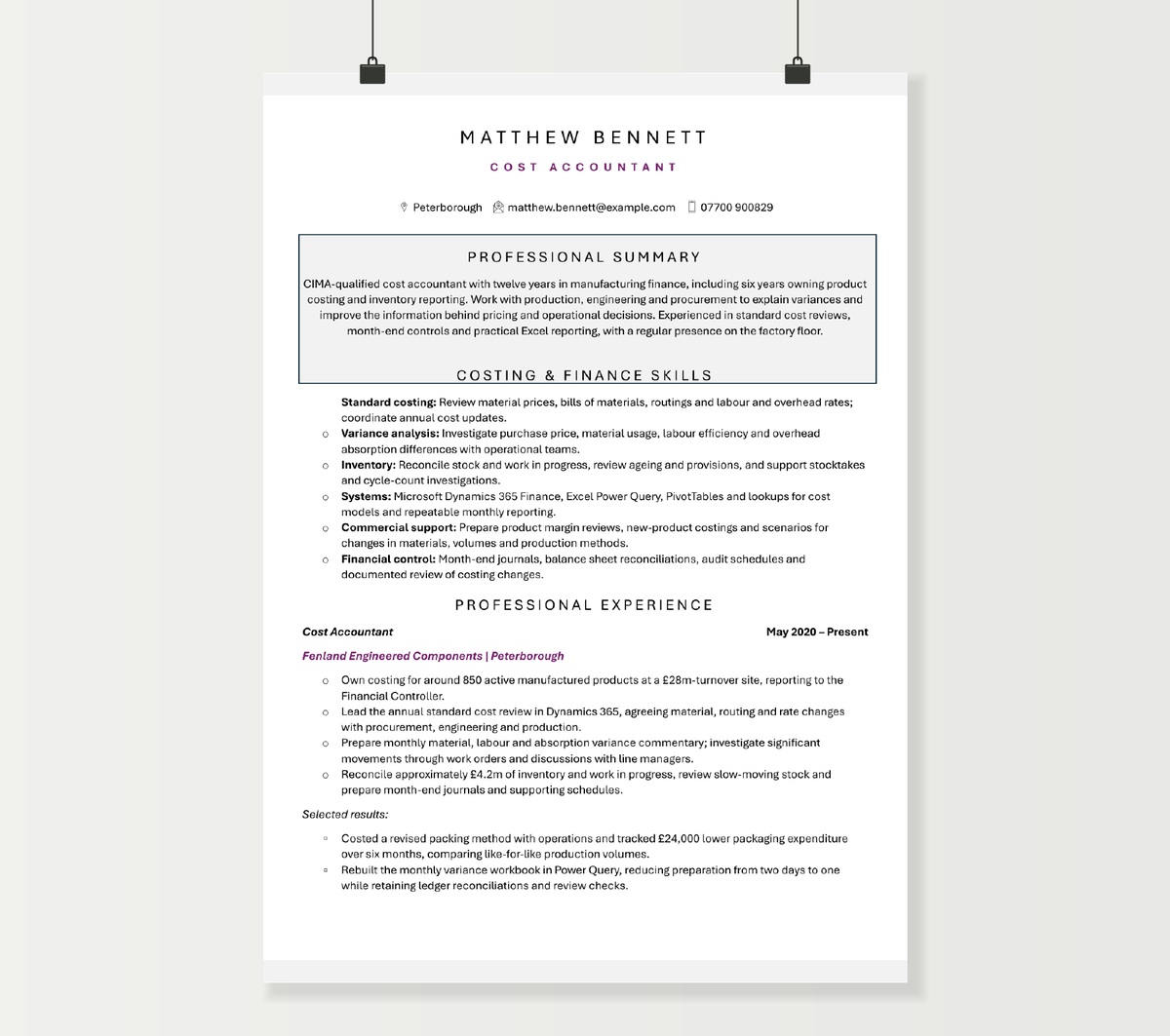
This cost accountant CV template presents a CIMA-qualified accountant who progressed from a graduate finance role into manufacturing costing. The Word example combines standard costs, inventory and variance analysis with evidence of working alongside production teams. The guide explains how to make the scope and commercial value of your costing experience clear.
Filename: FreeCVDownload_Cost_Accountant.docx
Content of this CV template
Matthew Bennett
COST ACCOUNTANT
Peterborough | [email protected] | 07700 900829
Professional summary
CIMA-qualified cost accountant with twelve years in manufacturing finance, including six years owning product costing and inventory reporting. Work with production, engineering and procurement to explain variances and improve the information behind pricing and operational decisions. Experienced in standard cost reviews, month-end controls and practical Excel reporting, with a regular presence on the factory floor.
Costing & finance skills
- Standard costing: Review material prices, bills of materials, routings and labour and overhead rates; coordinate annual cost updates.
- Variance analysis: Investigate purchase price, material usage, labour efficiency and overhead absorption differences with operational teams.
- Inventory: Reconcile stock and work in progress, review ageing and provisions, and support stocktakes and cycle-count investigations.
- Systems: Microsoft Dynamics 365 Finance, Excel Power Query, PivotTables and lookups for cost models and repeatable monthly reporting.
- Commercial support: Prepare product margin reviews, new-product costings and scenarios for changes in materials, volumes and production methods.
- Financial control: Month-end journals, balance sheet reconciliations, audit schedules and documented review of costing changes.
Professional experience
Cost Accountant | May 2020 – Present
Fenland Engineered Components | Peterborough
- Own costing for around 850 active manufactured products at a £28m-turnover site, reporting to the Financial Controller.
- Lead the annual standard cost review in Dynamics 365, agreeing material, routing and rate changes with procurement, engineering and production.
- Prepare monthly material, labour and absorption variance commentary; investigate significant movements through work orders and discussions with line managers.
- Reconcile approximately £4.2m of inventory and work in progress, review slow-moving stock and prepare month-end journals and supporting schedules.
Selected results:
- Costed a revised packing method with operations and tracked £24,000 lower packaging expenditure over six months, comparing like-for-like production volumes.
- Rebuilt the monthly variance workbook in Power Query, reducing preparation from two days to one while retaining ledger reconciliations and review checks.
Graduate / Assistant Management Accountant | Sep 2014 – Apr 2020
Westbridge Industrial Products | Stamford
- Joined the graduate finance programme and progressed to Assistant Management Accountant in 2017 while studying CIMA.
- Prepared production cost reports, accruals and stock reconciliations for two assembly departments using Sage 200 and Excel.
- Worked with purchasing on material price changes and helped maintain product cost sheets for quotations and budget reviews.
- Supported quarterly forecasts, comparing output, labour hours and overhead expenditure with budget assumptions.
Selected contributions:
- Investigated recurring stock-count differences with stores, tracing a unit-of-measure error affecting 18 components and supporting correction of the item records.
- Introduced a shared month-end evidence checklist for stock journals, making supporting records easier to retrieve during the annual audit.
Qualifications & development
CIMA Associate member — ACMA, CGMA – Admitted 2019; current member
BSc (Hons) Accounting and Finance — 2:1 – University of Lincoln, 2014
Microsoft Dynamics 365 Finance user training – Employer programme, 2021
Excel Power Query and financial modelling – Professional development, 2024
Additional information
- Operational working: Attend weekly production reviews and explain cost movements to supervisors using product and work-order examples.
- Finance teamwork: Provide holiday cover for overhead reporting and help colleagues maintain controlled Excel schedules.
- Interests: Cycling, local history and restoring old furniture.
How to write a cost accountant CV
A cost accountant CV is strongest when it connects the accounts to what happens in production. A hiring manager needs to see the costing environment you understand, the records and assumptions you worked with, and the decisions your analysis supported. Standard costing, inventory and variance analysis are useful headings; the evidence underneath them is what distinguishes an application.
Put your manufacturing environment in the opening lines
Explain what the business made and how it operated. Batch food production, precision components, assembly and engineered-to-order equipment create different costing demands. The number of sites, product range, inventory value or annual manufacturing spend can help establish scale, but choose the measures that illuminate your own responsibility.
For example, “Owned standard costing for 850 manufactured products at a £28m-turnover site” gives a clear starting point. A project-based applicant might instead describe the number and value range of live equipment orders and the monthly cost-to-complete reviews they supported. Add your reporting line or team context where it helps explain the level of ownership.
Use the profile to bring together your qualification status, sector background and the kind of costing work you do best. If the vacancy centres on manufacturing variances, that evidence should appear before general month-end reporting. If inventory control is its main problem, lead with stock, work in progress and the improvements you have made to the underlying records.
Describe the cost model you actually maintained
“Standard costing experience” can cover anything from supplying a spreadsheet to owning an annual cost roll. Make your contribution visible. State whether you reviewed material prices, checked bills of materials, challenged production routings, updated labour rates, reviewed overhead assumptions or loaded approved costs into the ERP system.
A strong bullet might read: “Coordinated the annual cost roll for 850 products, agreeing material prices and routing changes with purchasing and engineering before loading approved standards.” It tells the reader about scale, collaboration and responsibility in one sentence.
Where you identified a weakness in the model, describe the consequence for the business. Corrected production times might improve quotation margins; a revised bill of materials might explain a persistent usage variance. The CV needs the problem, your investigation and the resulting improvement in information. It does not need a worked costing calculation.
For new-product work, explain the stage at which you contributed and who used the costing. A quotation model, launch cost estimate and post-launch review show different experience. Mention scenario analysis where it helped colleagues compare batch sizes, sourcing options or manufacturing methods.
Take variance analysis beyond the report
Identify the variances you analysed: purchase price, material usage, labour efficiency, overhead absorption, scrap or rework. Then choose an example where you established why a movement occurred. This shows the depth behind a monthly commentary pack.
Compare “Produced manufacturing variance reports” with “Traced recurring material usage variances to incorrect units of measure in component records and worked with stores to correct the affected items.” The second version shows a connection between financial data and operational records, as well as what you did with the finding.
Experience on the factory floor belongs on the CV when it improved your analysis. Explain that you checked routings with engineering, reviewed overtime with production supervisors or compared recorded scrap with quality logs. This is a practical way to demonstrate constructive challenge and understanding of the business.
If you presented a recommendation, include the decision or follow-up. “Reviewed” and “analysed” become more convincing when the reader can see that the work led to a revised forecast, a production trial, a pricing review or an agreed control change.
Show the controls behind inventory and work in progress
Cost accounting relies on dependable stock records. Set out the inventory responsibilities you held: reconciling the subledger to the general ledger, reviewing work in progress, investigating stocktake differences, supporting cycle counts or preparing slow-moving-stock analysis.
Be specific about your level of responsibility. Organising a stocktake, reconciling the results and approving adjustments are separate contributions. Similarly, you may have prepared an obsolescence schedule for review, challenged the operational assumptions behind it or posted the approved provision. Clear verbs give the employer a useful view of your experience.
Include the financial close work that supports this: inventory and cost-of-sales journals, absorption adjustments, balance sheet reconciliations or year-end audit schedules. A brief example of resolving an old reconciling item or improving the evidence for a journal can demonstrate more than “supported the external audit”.
Inventory accuracy and inventory reduction are also different achievements. Correcting item records improves the reliability of the numbers. Reducing surplus stock involves a change in the stock held, often through purchasing or production action. Name the improvement so the result is easy to understand.
Explain savings and margin results precisely
Cost accountants may identify an opportunity, model its value, support implementation and then measure the outcome. Say which of those stages you completed. “Identified a £60,000 annualised opportunity” communicates something different from “verified £30,000 lower expenditure over six months following implementation”. Both can be useful evidence.
Give a time period and a meaningful comparison. If production volumes changed, explain briefly how you compared the result, such as like-for-like output or cost per unit. Where a result depends on a team effort, identify your analytical contribution alongside the change made by operations.
The example CV describes costing a revised packing method and tracking lower expenditure against comparable production volumes. It connects the model to an implemented change. For margin work, you might instead explain how an analysis informed a price review, exposed an unprofitable product mix or helped a project manager respond to additional costs.
Useful results need not be large cash savings. A more reliable standard cost, a reduction in unexplained variances, an earlier forecast warning or a faster reporting process with its reconciliations retained can be strong achievements. These outcomes show how your work improved decisions and financial control.
Give project costing its own evidence where relevant
For businesses delivering equipment or other long-running projects, make the project-accounting element visible in your employment history. State the types of projects, review cycle and forecasts you supported. Cost-to-complete, committed costs, changes in scope and margin movements are more useful details than a broad claim to project finance experience.
A concise example could describe challenging remaining engineering hours with a project manager, updating the forecast and flagging a margin risk before the next review. If you supported revenue recognition or percentage-of-completion calculations, identify the schedule or review you prepared and the accounting team’s oversight.
Applicants from repeat-product manufacturing can foreground transferable work such as work-order analysis, cost models and variance investigation. Applicants from project environments should make their experience of standard costs and inventory clear where the target role combines both.
Use systems evidence to demonstrate control of the data
List the ERP systems you know, then explain the relevant work. Dynamics 365, SAP, JD Edwards, Sage or another system is more persuasive alongside cost rolls, item records, bills of materials, work orders, inventory reports or reconciliations. If you helped implement or upgrade a system, specify the part you tested and the checks you performed before relying on the output.
Excel evidence should reflect your own models and recurring analysis. Power Query might combine monthly production exports; PivotTables might support a variance review; lookup formulas might connect product codes to standard costs. Include the controls that mattered, such as reconciling totals to the ledger or retaining a documented review of changes.
For Power BI or similar reporting, state what the report helped people do. A margin dashboard used in product reviews is stronger evidence when you explain the cost data, refresh process and decisions it supported. The CV should make clear whether you built the model, maintained the report or used it to interpret results.
Show influence through a particular decision
Cost accountants work across finance, production, procurement and engineering. Instead of reserving “business partnering” for a skills list, give an example of how you helped those colleagues reach a decision. You may have explained a cost movement to supervisors, challenged an outdated production assumption or compared the financial effects of two sourcing options.
Describe the audience and the useful outcome. “Presented a weekly material-usage review to production supervisors, agreeing investigation owners for the three largest adverse variances” conveys more than “excellent communication skills”. For a senior application, include how you guided other finance colleagues, improved the review process or established consistent costing across sites.
If the vacancy has a broader planning and stakeholder remit, the finance business partner example can help you decide which decision-making evidence deserves more space. Keep your production and costing expertise prominent so the application retains its specialist focus.
Balance qualifications with your level of experience
Make your accounting qualification or study status easy to find. A qualified applicant can include the professional body, designation and admission date. A part-qualified applicant can name the programme, completed stage and remaining study. Specific progress is more informative than simply “studying accountancy”.
For an experienced accountant qualified through practice rather than a professional award, use the opening section to establish the depth of your costing work and the responsibilities you own. Where the vacancy accepts equivalent experience, evidence of a complete cost cycle, inventory controls and operational recommendations can be central to the application.
For a trainee role, bring forward relevant degree modules, placements, finance work and manufacturing exposure. A costing project can be useful if you explain the data, assumptions and recommendation in a few lines. Customer pricing models, production reports or stock reconciliations completed under supervision are valuable early-career evidence.
If your current title is Management Accountant, retain it and make the costing responsibilities clear beneath it. The management accountant CV example offers a broader balance of reporting, planning and control; a cost-accounting application should give proportionately more space to product costs, inventory and manufacturing performance.
Cost Accountant CV FAQs
Read the responsibilities carefully because the titles can describe different work. A manufacturing cost accountant role commonly centres on product costs, inventory and financial reporting. A cost engineer vacancy may instead emphasise project controls, estimating, commitments and engineering progress. Use the same career history, but select evidence that matches the actual responsibilities and make your accounting or engineering background clear.
Highlight assignments involving stock, work in progress, inventory provisions, management accounts and manufacturing clients. Explain any direct discussions with production or finance teams and the records you examined. Then bring forward relevant costing study or projects. This helps the employer see the connection between your practice experience and the operational information used in a factory finance team.
You can usually explain the contribution without disclosing a customer's price or a product's precise margin. Describe the product family, issue and decision supported, using rounded values or an aggregate improvement where appropriate. A statement that your review informed repricing of a loss-making range can be useful even where the detailed commercial figures remain confidential.
Use the qualification's full name, awarding body and country, followed by any designation you currently hold. Add a short description of relevant manufacturing finance experience so the employer can assess it alongside the qualification. If you are also studying with a UK professional body or have a formal recognition assessment, list that separately with its current status.
A short, well-explained work sample can help when an employer requests one, particularly for an early-career or analytical role. It should let the reader understand the costing question, assumptions, checks and recommendation without needing a long demonstration. A self-contained model using public or synthetic information is easier to share than an employer's operational workbook. On the CV itself, a clear description of the project and its outcome is usually enough.




