
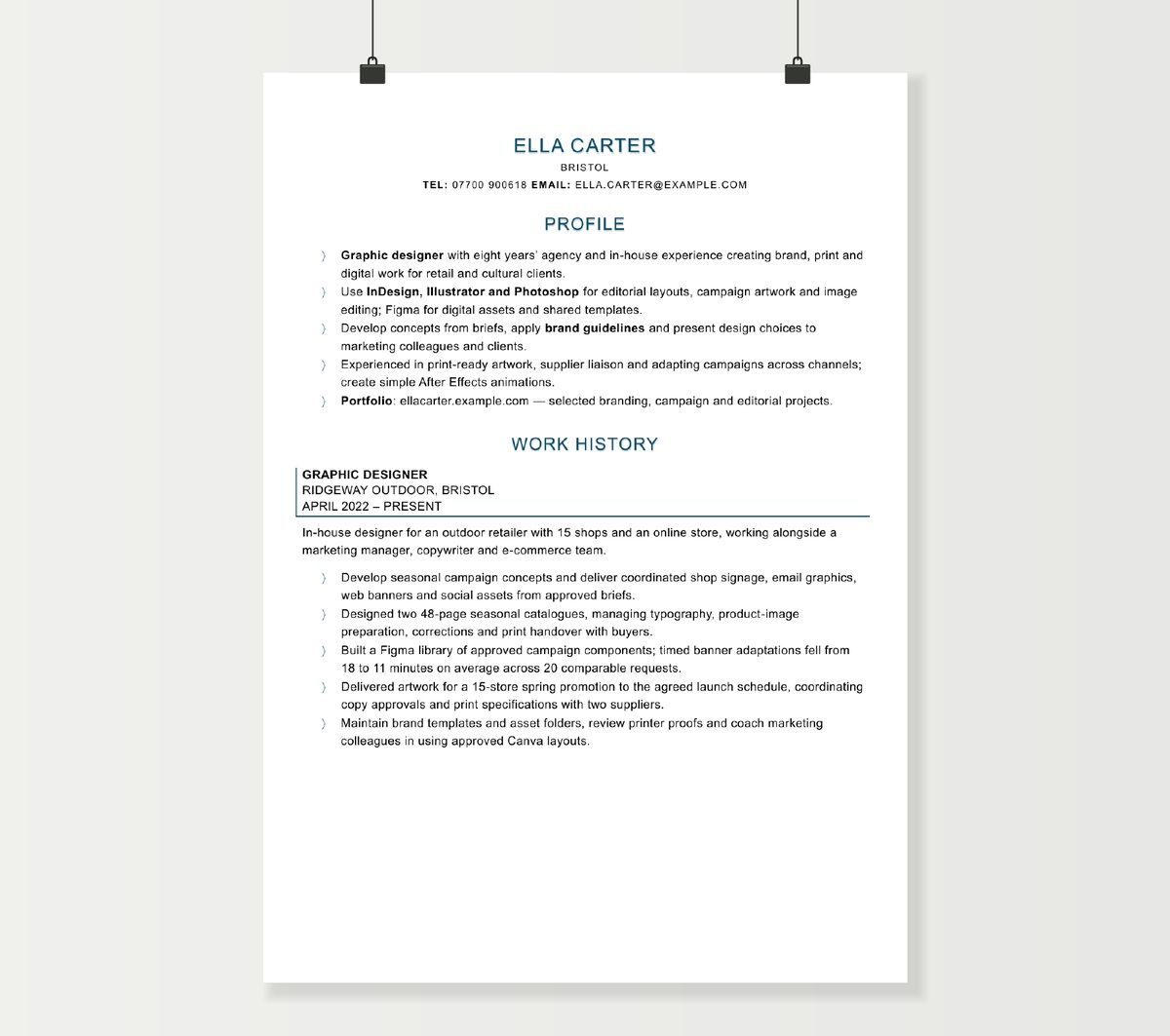
This graphic designer CV template follows a designer who moved from a small agency into an in-house retail team. The example combines brand and campaign work with typography, print production, digital assets and collaboration with marketing colleagues. The guide explains how to make your CV complement your portfolio, whether you are applying for a junior, freelance or experienced designer role.
Filename: FreeCVDownload_Graphic_Designer.docx
Content of this CV template
ELLA CARTER
BRISTOL
tel: 07700 900618 email: [email protected]
PROFILE
- Graphic designer with eight years’ agency and in-house experience creating brand, print and digital work for retail and cultural clients.
- Use InDesign, Illustrator and Photoshop for editorial layouts, campaign artwork and image editing; Figma for digital assets and shared templates.
- Develop concepts from briefs, apply brand guidelines and present design choices to marketing colleagues and clients.
- Experienced in print-ready artwork, supplier liaison and adapting campaigns across channels; create simple After Effects animations.
- Portfolio: ellacarter.example.com — selected branding, campaign and editorial projects.
WORK HISTORY
GRAPHIC DESIGNER
RIDGEWAY OUTDOOR, BRISTOL
APRIL 2022 – PRESENT
In-house designer for an outdoor retailer with 15 shops and an online store, working alongside a marketing manager, copywriter and e-commerce team.
- Develop seasonal campaign concepts and deliver coordinated shop signage, email graphics, web banners and social assets from approved briefs.
- Designed two 48-page seasonal catalogues, managing typography, product-image preparation, corrections and print handover with buyers.
- Built a Figma library of approved campaign components; timed banner adaptations fell from 18 to 11 minutes on average across 20 comparable requests.
- Delivered artwork for a 15-store spring promotion to the agreed launch schedule, coordinating copy approvals and print specifications with two suppliers.
- Maintain brand templates and asset folders, review printer proofs and coach marketing colleagues in using approved Canva layouts.
GRAPHIC DESIGNER
FOLD & FIELD STUDIO, BATH
SEPTEMBER 2018 – MARCH 2022
Joined as a junior designer in September 2018 and progressed to graphic designer in July 2020, working on arts, hospitality and independent retail accounts.
- Created identity concepts, posters and brochures, presenting options with the senior designer and developing the selected direction through client feedback.
- Designed an exhibition identity and 24-page visitor guide, adapting the approved system for signage, invitations and digital promotion.
- Prepared press-ready PDFs, checked image resolution and colour settings, and coordinated artwork queries with local printers.
- Supported six client websites with Figma page designs and exported assets, working with developers on responsive layouts and final visual checks.
EDUCATION & DEVELOPMENT
BA (HONS) GRAPHIC DESIGN, 2:1
UNIVERSITY OF THE WEST OF ENGLAND – 2018
Final project: visual identity and illustrated visitor materials for a local walking festival.
MOTION DESIGN FOUNDATIONS
AFTER EFFECTS SHORT COURSE – 2024
ACCESSIBLE DIGITAL DESIGN
WORKPLACE TRAINING – 2025
OUTSIDE WORK
I enjoy film photography, bouldering and going to small music festivals.
How to write a graphic designer CV
A design portfolio shows the work. Your CV explains the experience behind it: the briefs you have handled, the decisions you contributed to, the people you worked with and what you delivered. The two should make it easy for an employer to picture you in their studio or in-house team.
Begin with a short description of your design focus. A designer with editorial and print experience offers a different starting point from someone working mainly on digital campaigns, packaging or motion. Give the reader that distinction, then connect it to the work they are recruiting for. “Graphic designer with agency and in-house retail experience” has more substance than a profile built around being passionate, innovative and creative.
Give the CV and portfolio different jobs
Put your portfolio address where it is easy to find, normally alongside your contact details or near the profile. A readable address as well as a working hyperlink helps when a CV is printed or copied into an application system. If access is restricted, give a clear way for the reviewer to obtain it.
Choose portfolio projects that support the application, then use the CV to supply the missing context. A beautifully presented identity may leave a reviewer wondering whether you developed the concept, applied an existing system or produced the final artwork. A short CV entry can answer that question and point towards the relevant project.
For each selected project, consider the information a creative director cannot infer from the finished image:
- The brief and audience: what the design needed to communicate and who would use or see it.
- Your contribution: concept development, typography, illustration, artworking, production or a combination.
- The working context: client, internal team, collaborators, budget or delivery constraints where useful.
- The outputs and outcome: what was approved, produced, launched or adopted.
Keep the project titles consistent between the CV and portfolio. “Walking festival identity” on the CV and a recognisably matching case study in the portfolio gives the reviewer a straightforward route to the work. The CV can remain concise while the case study carries sketches, alternatives, rationale and final applications.
Turn design projects into useful experience entries
Under each employer, establish the studio or business context before describing projects. State whether you worked in-house, in an agency or independently, the main clients or audiences and your place in the team. That makes the scale of your responsibility easier to understand.
Then select work that shows both design thinking and delivery. “Designed brochures and social posts” identifies formats but says little about the work. “Developed an exhibition identity and 24-page visitor guide, adapting the approved design for signage and digital promotion” explains how the pieces belonged together.
A strong entry may follow a brief through several stages: developed initial directions, presented options, refined the chosen route with feedback and supplied final artwork. You do not need that full sequence in every bullet. Use it where it demonstrates a level of ownership that would otherwise be hidden.
For an in-house position, show how you worked within and developed an established brand over time. For an agency position, give evidence of moving between audiences and visual identities, interpreting different briefs and working with account managers or creative leads. A freelance role can add how you scoped requests, agreed milestones and managed client approvals.
Show the craft that matters to the vacancy
Typography and editorial layout
Editorial employers can assess typography in your portfolio, but the CV should explain the production experience behind it. Identify the publications you worked on, their length or complexity, and your responsibility for styles, image placement, corrections and final files. A 48-page catalogue with repeated product information presents a different challenge from a single-page poster.
Include collaboration with editors, copywriters or subject specialists where it affected the design. Managing rounds of corrections, maintaining consistent styles and resolving layout problems are useful evidence of being able to deliver a publication, as well as design an attractive spread.
Packaging and print production
For packaging, name the product categories and the stages you handled: concepts, range extensions, artwork on supplied cutter guides, material or finish discussions, proofs and final production files. Where structural design was handled by a specialist, your graphic-design contribution can still be substantial and deserves a clear description.
For broader print roles, describe supplier liaison and production responsibility. Preparing press-ready artwork, checking proofs, resolving printer queries and maintaining version control explain practical competence. The CV need not become a list of print settings; one well-chosen project can show that you understand the route from layout to finished item.
Digital campaigns and motion
Digital employers will want to see how you adapt a concept across placements and formats. Explain the channels, audience and working relationship with marketing or product colleagues. An asset library, a repeatable campaign system or a set of designs that developers could implement may be stronger evidence than the total number of banners exported.
Describe motion at the level you use it: animated typography, short social assets, storyboards or more substantial animation. Link this to a project in your portfolio when possible. Website page design, interface design and user research are also distinct contributions; naming your part helps an employer assess whether the experience matches their brief.
Make software skills meaningful
A clear software section helps a studio identify familiar tools, especially when it needs someone to join an existing workflow. Group tools by the work you do with them. InDesign may support long documents and styles; Illustrator may support vector artwork and identity assets; Photoshop may support retouching and image preparation; Figma may support digital layouts and shared components.
Give the core tools prominence and let employment or project entries demonstrate depth. “Created and maintained Figma campaign components for the marketing team” tells the reader more than a five-star rating. It also explains the task more clearly than treating all Figma experience as product design.
Canva can be relevant when the role includes templates for colleagues who are not designers. Explain your contribution to the system: designing the layouts, establishing controlled variations or helping colleagues use the templates. After Effects, Premiere Pro, Blender or other specialist software should receive space in proportion to their relevance to the vacancy and your work.
Training can sit beneath the software evidence. A short course is most useful when the CV also shows what it enabled you to make, such as animated campaign assets or a more accessible document layout.
Explain how you work with feedback and other people
Design is rarely delivered in isolation. Employers need to know how you clarify briefs, explain a visual direction, respond to feedback and keep work moving. Replace a general claim to be a good communicator with an example of those conversations.
You might have presented concepts to a client, worked through copy changes with an editor, coordinated a photographer’s image delivery or explained a production constraint to a marketing manager. These examples show judgement in the situations the new employer is likely to recognise.
For a senior role, make the leadership element explicit. Describe briefing freelancers, reviewing work, mentoring junior designers, setting standards or allocating studio capacity. Include the team size and decision-making scope. A senior title alone does not tell the reader whether your role involved people management, creative direction or specialist individual work.
Organisation also deserves concrete evidence: maintaining an asset library, managing versions, coordinating sign-off or balancing a launch campaign with routine production requests. These responsibilities are especially valuable in a small team where the designer must keep several streams of work moving.
Describe design impact without relying on sales figures
Design outcomes can be visible in the work’s adoption and delivery. A visual system rolled out across several sites, a publication delivered to schedule, a template library used by colleagues or a campaign adapted consistently across channels all show practical value.
Where you have measured production improvements, give the task and comparison. The example CV describes the time required for comparable banner adaptations before and after a component library was introduced. That is a result close enough to the designer’s own work to explain clearly.
Campaign figures can also be useful when you have access to them. Identify the creative you contributed, the channel and the measurement period. If a marketing team tested two designs under comparable conditions, that can provide a focused result. If a broader campaign increased sales, explain your design contribution within that campaign rather than letting a single figure stand alone.
Qualitative evidence can carry weight too: a chosen concept, positive client feedback on usability, approval for a wider rollout or repeat commissions. Give enough context to show why the outcome mattered. “Identity selected for the organisation’s annual festival and applied to signage, print and ticketing” says more than “successful branding project”.
Build a convincing CV at your career stage
Junior designers and graduates
Selected projects can take more space than employment when they are your strongest evidence. Include the brief, your role, the outputs and the decisions you made. University, college, competition and self-directed work can all demonstrate relevant skills; a short label gives the reader the context.
For group projects, describe your contribution and how you collaborated. For a live brief, explain the contact with the organisation and what was taken forward. Placements and small freelance commissions are useful because they can show feedback, deadlines and production constraints alongside visual ability.
Keep part-time work concise but retain relevant evidence, such as dealing with customers, coordinating a busy shift or meeting operational deadlines. Your portfolio and selected design projects should still receive the main attention. The template collection offers other layouts if your balance of projects and employment differs from this example.
Experienced and freelance designers
Let recent, relevant work take the most space. Show progression through more complex briefs, greater independence, stronger client relationships or responsibility for other designers. Earlier roles can establish the foundation without repeating every production task.
Freelance work is usually easiest to follow under one dated heading, with selected clients or projects beneath it. Explain the kinds of commissions and your ongoing responsibilities, then choose examples that match the vacancy. Regular part-time retainers can be labelled so overlapping dates make sense.
A design degree, HND, apprenticeship or other training belongs in education, but the emphasis changes as your portfolio and experience grow. Keep relevant recent development and awards with clear names and dates. If you are moving into a role that combines design with channel planning and reporting, the social media manager example shows how to present that wider responsibility.
Let the CV itself demonstrate clear visual judgement
Your CV is a small piece of information design. Use a readable hierarchy, consistent spacing and enough contrast for the text to remain clear when printed. The reader should be able to find roles, dates, skills and the portfolio address without decoding the layout.
A restrained design can still show care through typography, alignment and composition. Keep image-heavy case studies in the portfolio, where they have room to work. Preserve editable text in the CV and check the exported file as well as the source document; a substituted font or a broken link can change the experience of reading it.
Before sending, read the CV alongside the selected portfolio. The titles, dates, project names and descriptions of your contribution should tell a coherent story. That relationship is what makes the application useful to someone deciding which designer to meet.
Graphic Designer CV FAQs
Where you have permission to show the work, give a short project credit identifying the agency, collaborators and your contribution. The CV can use the same project name and describe the stages you handled. This makes collaborative work useful evidence, whether you developed the initial concept, designed particular applications or prepared the final artwork.
Use the CV to describe the type of client, brief, deliverables and your responsibilities without identifying restricted details. Ask whether a redacted case study or a private presentation is permitted. If neither is possible, other published work or a relevant self-directed project can demonstrate the visual skills, while the CV establishes your recent professional experience.
Yes, if the reviewer can access the relevant work easily and sharing it is permitted. Supply the access details in the application where appropriate, check the link outside your logged-in session and make clear which projects you want the employer to see. If the vacancy asks for an attached PDF instead, prepare that selection in the requested format.
Group commissions under a dated freelance designer heading and use selected projects or retained clients as subentries. A note such as “part-time retainer” explains ongoing work alongside another role. For agencies, naming the agency and describing the end-client sector may be the clearest option where the client name is not public.
Yes. Give it a clear project label and explain the brief you set yourself. It can be particularly useful when applying for a new specialism that your paid work has not yet covered. On the CV, keep selected personal or study projects in a separate section when that helps the reader follow the employment history.
Follow the employer’s requested format. A PDF is useful for preserving the appearance of a completed design, while a Word file may be specifically requested by a recruiter or application process. Keep the text selectable, check the portfolio hyperlink after export and open the final file on another viewer if possible. A portfolio PDF is normally a separate document unless the application asks for a combined submission.
Include them when they are relevant to the employer and you can describe a useful part of your workflow, such as exploring early directions or speeding up a defined production task. Give more space to the design judgement and finished work than to the tool name. Application instructions and attitudes to these tools vary between employers, so use the vacancy’s requirements to decide what belongs in that particular submission.




