
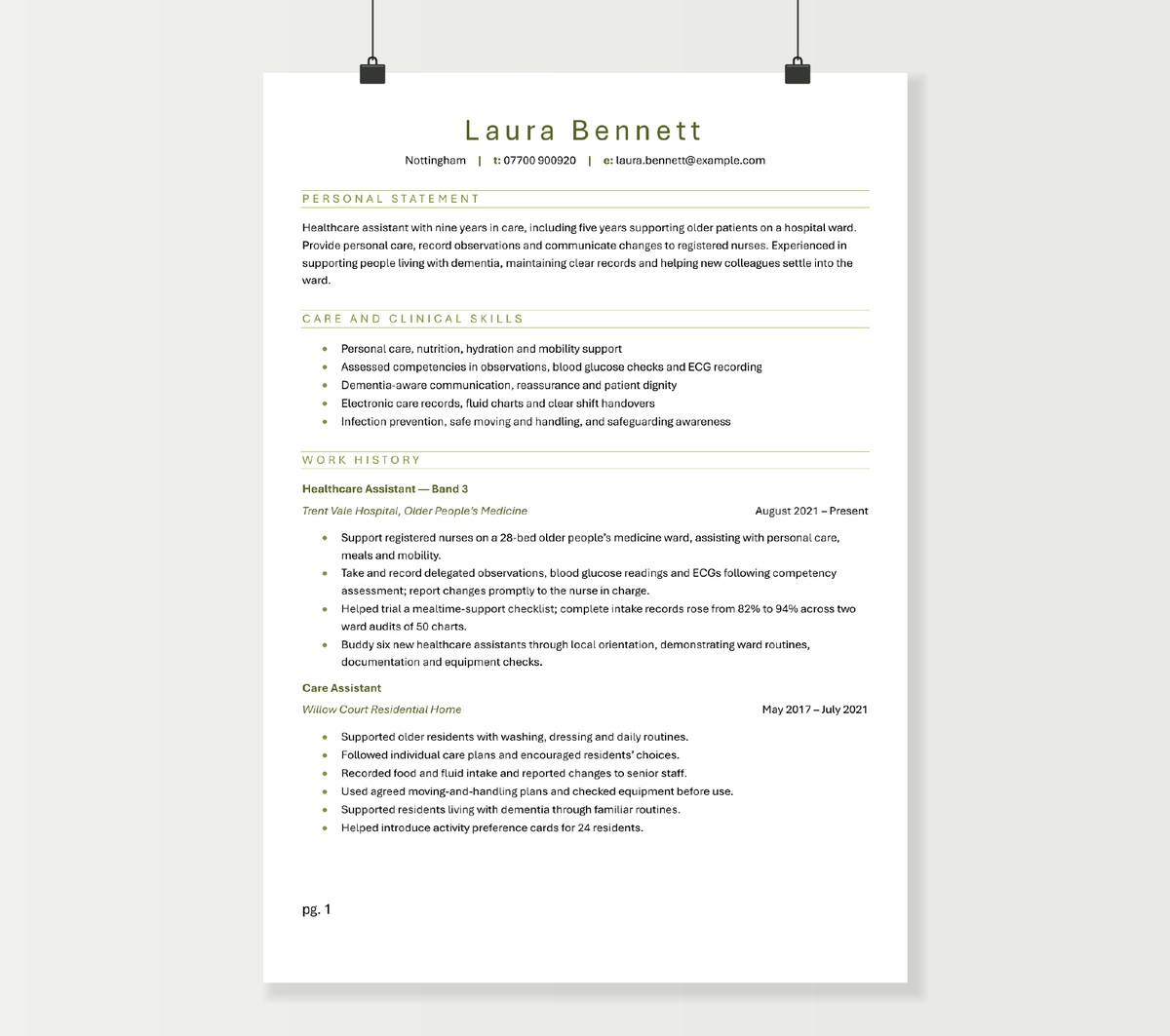
This healthcare assistant CV template follows a care assistant into a hospital ward role supporting older patients. The Word example combines personal care, assessed clinical skills, communication and practical contributions to the ward. The guide covers hospital, community and primary-care applications, including first healthcare roles and progression within clinical support.
Filename: FreeCVDownload_Healthcare_Assistant.docx
Content of this CV template
Laura Bennett
Nottingham | t: 07700 900920 | e: [email protected]
Personal statement
Healthcare assistant with nine years in care, including five years supporting older patients on a hospital ward. Provide personal care, record observations and communicate changes to registered nurses. Experienced in supporting people living with dementia, maintaining clear records and helping new colleagues settle into the ward.
Care and clinical skills
- Personal care, nutrition, hydration and mobility support
- Assessed competencies in observations, blood glucose checks and ECG recording
- Dementia-aware communication, reassurance and patient dignity
- Electronic care records, fluid charts and clear shift handovers
- Infection prevention, safe moving and handling, and safeguarding awareness
Work history
Healthcare Assistant — Band 3
Trent Vale Hospital, Older People’s Medicine
August 2021 – Present
- Support registered nurses on a 28-bed older people’s medicine ward, assisting with personal care, meals and mobility.
- Take and record delegated observations, blood glucose readings and ECGs following competency assessment; report changes promptly to the nurse in charge.
- Helped trial a mealtime-support checklist; complete intake records rose from 82% to 94% across two ward audits of 50 charts.
- Buddy six new healthcare assistants through local orientation, demonstrating ward routines, documentation and equipment checks.
Care Assistant
Willow Court Residential Home
May 2017 – July 2021
- Supported older residents with washing, dressing and daily routines.
- Followed individual care plans and encouraged residents’ choices.
- Recorded food and fluid intake and reported changes to senior staff.
- Used agreed moving-and-handling plans and checked equipment before use.
- Supported residents living with dementia through familiar routines.
- Helped introduce activity preference cards for 24 residents.
Retail Assistant
Meadow Lane Stores, Nottingham
July 2014 – April 2017
- Helped customers with enquiries and purchases in a local store.
- Handled payments and balanced the till at the end of each shift.
- Supported customers who needed extra time or help with shopping.
- Trained three new colleagues in customer service and stock routines.
Qualifications & training
Level 2 Diploma in Care
NCFE CACHE — workplace assessment
2019
- Care Certificate — completed through workplace assessment, 2017.
- Ward clinical competency assessments — completed 2021; reviewed 2026.
- Basic life support, safeguarding and infection-prevention updates — 2026.
GCSEs
Nottingham
2014
- Six GCSEs at grades A–C, including English and Mathematics.
Hobbies and interests
- Walking: Weekend walks with a local group.
- Baking: Making cakes and bread for family and friends.
- Swimming: Regular sessions at the local leisure centre.
Additional information
Experienced in day, night and weekend ward shifts.
How to write a healthcare assistant CV
A healthcare assistant CV should help an employer understand the care you have provided, the people you have supported and the clinical setting you know. Hospital wards, community teams and GP practices use healthcare assistants in different ways, so the responsibilities in the vacancy should guide the evidence you bring forward.
Good examples can come from everyday care as well as additional clinical skills. Helping someone eat comfortably, recognising a change and passing it to the nurse, or keeping a clear record can all demonstrate a valuable contribution when described precisely.
Make the setting and patient group clear
Begin each recent role with a short description of where you worked. An older people’s ward, a surgical unit, an outpatient clinic and a community nursing service have different routines and patient needs. Include the patient group and the team you worked alongside.
The size of the ward or service can establish context, but the reader also needs to understand your own work. Laura’s example identifies a 28-bed ward and then describes the personal care and delegated activities she undertakes with registered nurses.
For a community role, explain the kinds of visits and the multidisciplinary team involved. For primary care, identify the clinics or patient groups you supported and the relevant procedures or administrative responsibilities. A short, specific introduction is more useful than “worked in a busy healthcare environment”.
Describe personal care as skilled, attentive work
Give personal care enough detail to show how you supported comfort, dignity and independence. Washing, dressing, nutrition, hydration, mobility and continence support may all be relevant. Select the activities that reflect your experience and the target role.
Then add what made your approach effective. You may have adapted communication for someone living with dementia, helped patients express preferences, supported a rehabilitation plan or coordinated mealtime assistance with colleagues. These examples show how you responded to the person’s needs.
A CV bullet can connect the care activity with its purpose: supporting mobility in line with an agreed plan, encouraging participation in daily routines or recording intake so the clinical team had reliable information. This is stronger evidence than repeating “caring and compassionate” throughout the document.
Present clinical skills with the context employers need
Use a focused clinical-skills section when the vacancy asks for particular competencies. Depending on the setting, relevant experience might include physiological observations, blood glucose checks, ECG recording, phlebotomy or other delegated activities.
For each important skill, make its practical status easy to understand. Include where you used it, the patient group and relevant workplace assessment or recent review. A concise statement such as “ECG recording following ward competency assessment” gives more information than the word “ECGs” alone.
Recording findings and communicating them to the responsible clinician are also part of the evidence. A description of taking observations becomes more complete when it shows the documentation and reporting that followed. The CV needs that professional context, rather than instructions on carrying out a procedure.
Keep the skills relevant to the application. A GP-practice role may give considerable weight to phlebotomy and clinic support, while a ward post may emphasise personal care and observation competencies. Where a role offers development, your existing care foundation and capacity to learn can be important parts of the application.
Use communication examples that fit patient care
Explain whom you communicated with and why. Reassuring a person before an investigation, helping a family understand the ward routine, adapting an explanation or contributing to a shift handover each demonstrates a different aspect of the role.
For dementia, learning-disability or mental-health experience, describe a practical adaptation that helped the person participate in their care. Familiar routines, communication aids or working with colleagues who knew the patient well can provide useful examples.
Paediatric applicants can show how they supported children and families, including age-appropriate reassurance and working alongside registered staff. Community applicants can emphasise communication during visits and keeping the wider team informed. The details should reflect the people and setting you actually worked with.
Show observation, reporting and teamwork together
Employers need healthcare assistants who notice relevant changes and communicate them clearly. A brief example can show that you recognised a concern, informed the appropriate colleague and contributed to the agreed response. Focus on your actions and the quality of the communication.
Teamwork becomes clearer when it identifies the practical contribution. You might have coordinated personal care around therapy sessions, prepared a patient for an appointment, supported a colleague during a busy shift or improved a handover routine.
For experienced applicants, helping new starters can be a useful achievement. State whether you acted as a buddy, demonstrated local routines or held an assessed training responsibility. Laura’s CV describes local orientation for six healthcare assistants, making the scope of that support clear.
Give documentation and digital skills a practical role
Describe the records you completed, such as care notes, fluid charts, observation records or clinic information. The useful evidence is that you maintained information the team could rely on and communicated outstanding issues appropriately.
If a vacancy names a clinical system you have used, include it with the relevant task. Community work may involve mobile records, while primary-care experience may include registrations, appointment information or clinic documentation. A general statement about electronic patient records is suitable when the particular system adds little to the application.
Other practical responsibilities can support the CV too: checking equipment, preparing clinical areas, maintaining stock or helping with audit information. Connect these with a dependable service rather than allowing them to become an unrelated list of chores.
Choose achievements that suit a healthcare support role
An achievement can be an improvement in the way care was organised or recorded. Examples include a clearer handover, better completion of a particular chart, a useful patient-information resource or a successful contribution to a ward initiative.
Where numbers help, explain what was measured. Laura’s example gives two audits of 50 charts and the change in complete intake records. It also identifies her contribution to a trial led within the ward. This makes the result understandable and keeps the focus on the work she performed.
Other strong evidence may be qualitative. Positive feedback about reassurance, being asked to support new colleagues or helping a patient engage with an agreed routine can show the quality of your work. A small number of well-described contributions can give the CV substance without turning care into a set of targets.
Separate qualifications, induction and clinical assessment
Use the full titles and dates of relevant qualifications. A diploma, an apprenticeship, the Care Certificate and a workplace clinical competency assessment provide different information. Giving each its own clear entry helps the employer compare your evidence with the person specification.
For the Care Certificate, state completion and the employer or workplace assessment context where useful. Relevant refresher learning can sit in a short training entry. Select current topics that matter to the role, such as basic life support, infection prevention, safeguarding or moving and handling.
Band and entry requirements vary between posts. Some employers ask for a particular qualification; others accept a defined equivalent-experience route or provide development after appointment. Use your CV to make the relevant qualification and assessed experience easy to find. The supporting information can explain the match in greater detail.
For applications elsewhere in the UK, use the qualification and induction terminology relevant to your own employment and the advertised role. The example’s Care Certificate experience relates to work in England.
Build a first healthcare application from relevant experience
Applicants moving from care homes or home care can bring forward personal care, communication, records, teamwork and supporting people with particular needs. Then explain any hospital placements, clinical training or other experience relevant to the new setting. The care assistant CV example can help you present that earlier social-care work.
For a first care role, draw on work, volunteering or personal caring experience that demonstrates patience, reliability and responding to other people’s needs. Describe personal caring separately from paid employment so the reader understands the context. Customer-facing work can support the application through clear examples of communication and dependable teamwork.
Students can include relevant placements, with dates, setting and the activities undertaken. Put the experience most relevant to the vacancy near the top, followed by qualifications and supporting employment. A clear account of a few useful experiences is enough to give the recruiter something meaningful to assess.
Use the CV alongside NHS supporting information
Where an application asks for supporting information, use the CV as a concise record of your history and evidence. The supporting section can then address the essential and desirable criteria with fuller examples. Follow the application’s requested fields and format.
Prepare examples that show what you did, how you worked with others and what the contribution achieved. Patient communication, care records, clinical competencies, teamwork and learning may each need a different example. This helps the application demonstrate the breadth of your experience.
A final review should leave a clear picture of the setting you know, the care you provide, the skills you have developed and the contribution you would bring to the team.
Healthcare Assistant CV FAQs
Employers use both titles, and the duties can overlap. Keep your actual job title in the employment history and use the profile to explain the setting and work you do. When applying, match your evidence to the responsibilities and person specification rather than relying on the title alone.
List the bank or agency as the employer and give the overall dates. Under that entry, identify the main wards or settings and any longer placements that are particularly relevant. This shows the continuity of your work while making the range of experience clear. A separate entry can help when a substantial placement involved a distinct role or progression.
Including it beside an NHS job title can help explain the appointment, especially when your history includes progression. Add the duties and assessed competencies so the reader can understand the role itself. For work outside the NHS, your actual title, care setting and responsibilities provide the relevant context.
List it as in progress and give the employer or assessment setting, with an expected completion date if one has been agreed. Completed qualifications and separately assessed clinical competencies can have their own entries. This gives the recruiter a clear picture of your current learning and experience.
A CV for an HCA application can draw on relevant care, communication and teamwork experience from overseas nursing. State the original role, country, qualifications and any professional registration clearly, then focus the profile on the support role being sought. This helps the employer understand both your background and the responsibilities you are applying to undertake.
A short account of your contribution can be useful, using a general description of the situation and the care setting. Focus on how you communicated, supported the person or worked with the team. The reader needs to understand your actions and judgement; identifying details about the patient are unnecessary to that explanation.
Use a brief additional-information line when it is relevant to the vacancy. Ward roles may involve days, nights and weekends, while community posts may require travel between visits. Your work history can show previous experience of those arrangements; the availability line can explain what you can offer for the new role.




