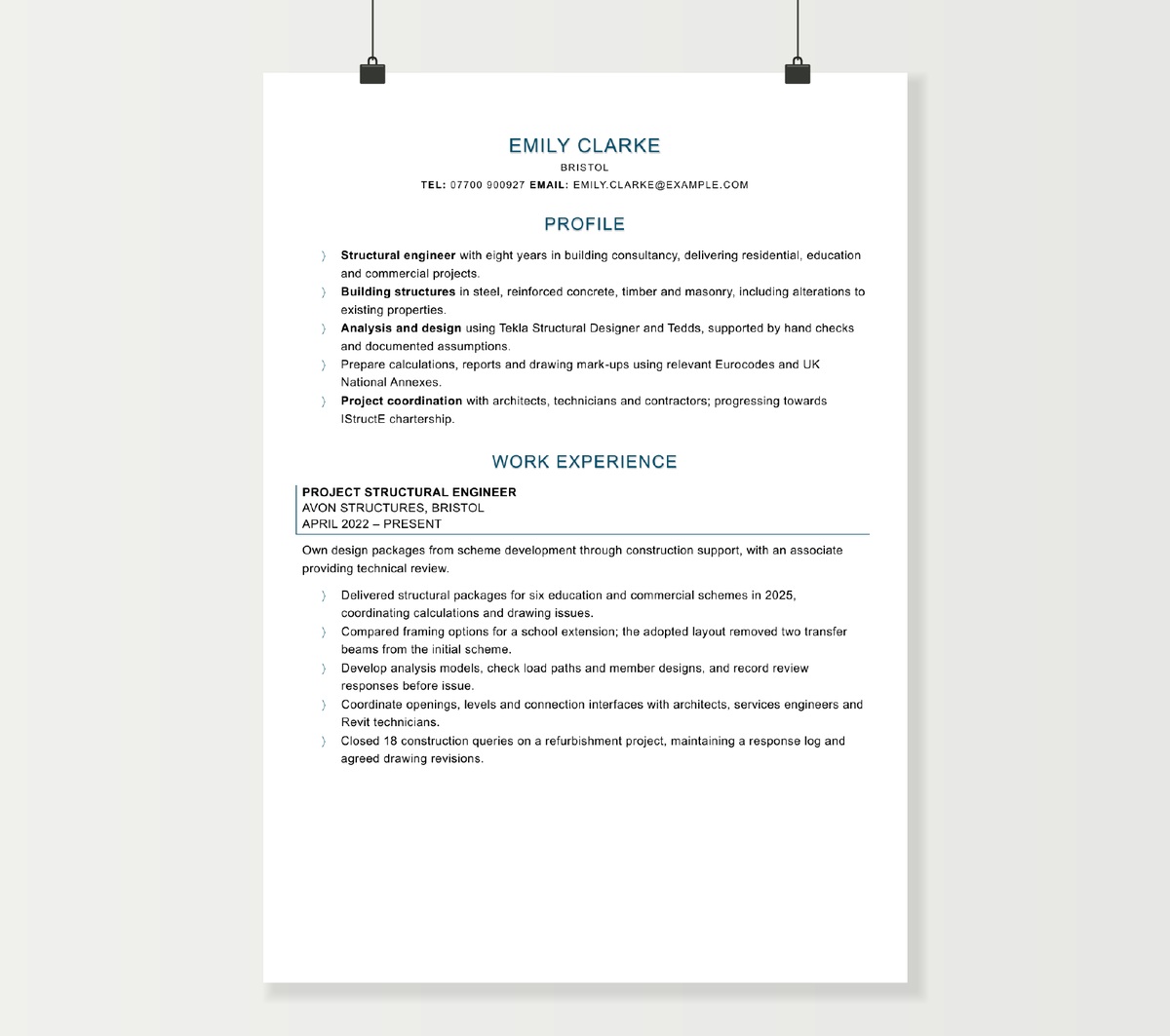
This structural engineer CV template shows progression from graduate design work to owning building-structures packages. The Word example covers analysis, calculations, coordination and construction support. The guide explains how to present your project decisions, material knowledge, technical responsibility and professional development.
Filename: FreeCVDownload_Structural_Engineer.docx
Content of this CV template
EMILY CLARKE
BRISTOL
tel: 07700 900927 email: [email protected]
PROFILE
- Structural engineer with eight years in building consultancy, delivering residential, education and commercial projects.
- Building structures in steel, reinforced concrete, timber and masonry, including alterations to existing properties.
- Analysis and design using Tekla Structural Designer and Tedds, supported by hand checks and documented assumptions.
- Prepare calculations, reports and drawing mark-ups using relevant Eurocodes and UK National Annexes.
- Project coordination with architects, technicians and contractors; progressing towards IStructE chartership.
WORK EXPERIENCE
PROJECT STRUCTURAL ENGINEER
AVON STRUCTURES, BRISTOL
APRIL 2022 – PRESENT
Own design packages from scheme development through construction support, with an associate providing technical review.
- Delivered structural packages for six education and commercial schemes in 2025, coordinating calculations and drawing issues.
- Compared framing options for a school extension; the adopted layout removed two transfer beams from the initial scheme.
- Develop analysis models, check load paths and member designs, and record review responses before issue.
- Coordinate openings, levels and connection interfaces with architects, services engineers and Revit technicians.
- Closed 18 construction queries on a refurbishment project, maintaining a response log and agreed drawing revisions.
GRADUATE STRUCTURAL ENGINEER
WESTFIELD CONSULTING, BATH
SEPTEMBER 2018 – MARCH 2022
Supported engineers on new-build housing, small commercial developments and existing-building alterations.
- Prepared beam, column and foundation calculations in Tedds, with independent hand checks for senior review.
- Produced AutoCAD details and marked up drawings for the technician team.
- Recorded site observations and helped prepare appraisal reports and investigation recommendations.
- Created a calculation-register template adopted across the four-person team, linking design revisions to drawing issues.
QUALIFICATIONS & DEVELOPMENT
MEng CIVIL ENGINEERING — 2:1
UNIVERSITY OF SHEFFIELD — 2018
Final-year project: comparison of steel and reinforced-concrete framing options for a teaching building.
PROFESSIONAL DEVELOPMENT
IStructE GRADUATE MEMBER; MENTORED IPD
RECENT CPD
EXISTING STRUCTURES, DESIGN RISK AND EMBODIED CARBON — 2025–2026
INTERESTS
Swimming, hillwalking and sketching buildings.
How to write a structural engineer CV
A structural engineer CV needs to reveal the engineering behind the project names. Employers want to understand the structures you have worked on, the decisions you contributed, the calculations and information you produced, and the level of responsibility you held.
Use project evidence to connect technical capability with delivery. A list of materials and software gives the reader a starting point; a clear account of a design package, assessment or construction issue shows how you apply that capability.
Establish your engineering context
Open with your principal area of practice: building structures, bridges, industrial facilities, temporary works, existing-building assessment or another specialism. Include the sectors, structural forms and materials that make your experience relevant to the vacancy.
For buildings work, the balance between new construction, refurbishment and alterations can matter as much as project size. A candidate used to designing new frames brings different evidence from someone who regularly assesses incomplete records, coordinates opening-up investigations and develops strengthening options.
Make your professional stage clear. Emily’s example describes eight years in consultancy and responsibility for design packages with associate review. Her chartership development is stated separately, so the reader can understand both her current work and her professional progression.
Choose projects for the responsibility they demonstrate
Select a small number of projects that show range or depth relevant to the application. Each should earn its space by revealing a particular contribution: scheme selection, detailed design, an existing-structure assessment, a difficult interface or construction-stage problem-solving.
A useful project entry answers the following questions:
- What was being built, assessed or altered?
- What structural system, material or constraint mattered?
- Which stage and package did you own?
- What analysis, coordination or judgement did you contribute?
- What design information or project decision resulted?
These details can sit in employment bullets. For an experienced applicant with several substantial schemes, a selected-projects section may make them easier to compare. Keep the connection to the employer and your role clear, particularly when a project spans several years.
Project value, floor area or storey count can provide scale, but your contribution should remain the centre of the entry. Responsibility for a complete small-building package may be more useful evidence than a brief involvement in a much larger development.
Explain analysis, design and checking as distinct contributions
Describe what your model or calculation was intended to resolve. A CV can identify global stability, member design, foundation behaviour, vibration, an altered load path or another relevant design question without becoming a calculation report.
Then explain your part: developing the analysis model, selecting assumptions, preparing calculations, comparing options, interpreting results or checking another engineer’s work. Where appropriate, mention hand checks, sensitivity work or independent review. This helps the employer assess the depth of your involvement.
“Used Tekla Structural Designer” is more informative when connected to a structural system and deliverable. For example, an employment bullet can describe modelling a steel frame, reviewing load paths and coordinating member sizes with the drawing team. A separate technical-skills line can list the software without repeating the whole story.
For checking experience, identify the work reviewed and your place in the review process. Calculation checking, drawing coordination and formal technical approval carry different responsibilities. The CV benefits from clear descriptions of each.
Give materials knowledge a project setting
Steel, concrete, timber and masonry are useful search terms, but the stronger evidence shows the forms and details you know. Examples might include steel frames and connections, reinforced-concrete slabs, timber roof structures or masonry alterations. Choose the experience relevant to the employer’s workload.
Connect the material to a design issue or deliverable. Emily’s school-extension example explains a framing comparison and the resulting removal of two transfer beams from the initial scheme. The value lies in showing a design decision, rather than adding an unsupported cost or carbon figure.
For specialist applications, bring the relevant technical work forward. Bridge assessment, protective design, seismic analysis or temporary works may require a different project selection from a general buildings role. A broad CV can be adapted by changing the emphasis and order of genuine project evidence.
Show how you work with existing structures
Existing-building work often depends on interpreting information as well as producing calculations. Describe the records you reviewed, inspections or investigations you helped plan, the assessment you completed and the recommendations or design that followed.
A concise entry could explain an appraisal supporting a change of use, an assessment of proposed openings or a strengthening scheme for an altered load path. State the scope of your involvement and the deliverable, such as an appraisal report, investigation brief or design package.
Site experience deserves more detail than “attended site visits”. Explain whether you recorded observations, checked work against drawings, investigated a reported issue, discussed buildability with the contractor or followed up technical actions. This shows how your site work informed the engineering.
Make coordination and construction support tangible
Employers need engineers who can get a design into usable information. Describe the interfaces you resolved with architects, building-services teams, geotechnical engineers, contractors and technicians. Openings, levels, foundations, connection assumptions and construction sequence can all provide useful examples.
Show how you managed changes. A construction-query log, revised calculation package or coordinated drawing issue can demonstrate control of the design as information develops. Emily’s example uses 18 closed queries on one refurbishment project, with the response record and drawing revisions giving the number meaning.
For BIM and drawing tools, distinguish authoring from coordination. Producing Revit models, reviewing a model, issuing mark-ups and resolving interfaces with a technician are different forms of experience. Explain the work you do and name the relevant tools alongside it.
Present standards, design risk and sustainability through evidence
State the design frameworks relevant to your projects, including the jurisdiction and appropriate standards or National Annexes. Keep the list selective. An employer can assess the knowledge more readily when a project entry also shows how you used it.
Design-risk work can appear through the documents and decisions you contributed: identifying significant risks, recording assumptions, communicating residual risks or coordinating a change with the project team. Describe your role within the design process rather than filling the CV with regulatory explanations.
For sustainability, give an engineering example such as retaining an existing frame, comparing structural options, reducing material quantities or assessing embodied carbon. Identify whether a result was a design-stage estimate, an adopted design change or a measured project outcome.
A carbon or tonnage figure is most useful with a comparison basis and scope. If the project did not produce a reliable numerical result, the options assessment and decision can still demonstrate valuable work.
Show the delivery responsibilities expected at senior level
Senior and associate applications should include the work around technical design: defining scope, planning resources, managing programme, reviewing deliverables, coordinating other disciplines and maintaining client relationships.
Give concrete evidence of leadership. Explain the engineers or technicians you supported, the packages you reviewed and how you helped the team deliver. Mentoring a graduate through a calculation package is a useful example; for a larger remit, include responsibility for several projects or a discipline team.
Commercial work can include fee proposals, monitoring time against budget, managing additional services or supporting repeat commissions. Describe the responsibility and result at the level you held. This complements the technical evidence and helps distinguish a senior CV from a longer version of a graduate one.
Use qualifications and development to support your next step
List your degree title, institution, classification where useful and completion date. Add current professional membership and registration clearly. Applicants working towards chartership can state their institution and a meaningful milestone, such as mentored IPD or preparation for professional review.
Choose recent CPD that relates to the work you want to do. Existing structures, particular materials, digital analysis, embodied carbon and design risk may be more useful than an exhaustive record of every webinar. A short entry can link the development to your project responsibilities.
Graduate applicants can give more space to a substantial design project, placement or dissertation. Explain the structural question, your individual contribution, method and outcome. A group design project is strongest when the CV identifies your own package and the coordination with the rest of the team.
For a first role, calculations, sketches, a concise report and an understanding of construction can provide evidence alongside software exposure. As professional experience grows, replace detailed module lists with completed design work and increasing responsibility.
If your experience spans structures and infrastructure, the civil engineer CV example can help you compare the emphasis. More editable layouts are available in the template library.
Structural Engineer CV FAQs
Yes, where these are your current registration and membership designations. They give a recruiter useful information quickly. Include a professional-qualifications entry as well, with the institution and date. If you are progressing towards chartership, a short statement of your current stage is more informative than placing a future designation after your name.
Yes. State the country, applicable design framework and your responsibility. Highlight transferable analysis, material knowledge, coordination and construction experience, then make any UK project work or recent UK-focused development easy to find. This helps an employer understand both your established expertise and the context of your experience.
A short project sheet or portfolio can help when the employer requests it or when selected diagrams make your contribution easier to explain. Include a brief, readable account of the structural problem and your work. The CV should still stand on its own, with a portfolio link or attachment providing optional detail.
Use material that you have permission to share, or describe the project in text with a suitable anonymised diagram of your own. A project type, structural system, challenge and clear account of your contribution can provide strong evidence without reproducing a confidential drawing package.
State the scope of your check and the review arrangement. For example, describe checking member calculations or coordinating drawing comments for an associate’s final review. This presents checking experience clearly while helping the employer understand the responsibility you already hold.
Keep the contracting arrangement and dates clear, then group assignments under the relevant consultancy or your contracting business where appropriate. Give each selected assignment a project type, package and deliverable. This shows continuity and technical range without repeating identical duties for every short placement.
A shared career record is useful, but the opening profile and project selection should reflect the advertised role. For structures, bring analysis, structural systems, materials and design delivery forward. For infrastructure-led roles, drainage, highways, earthworks or other relevant civil work may deserve more space. Combined roles can use a clearly labelled balance of both.